
Diogmites properans
Bromley, 1936
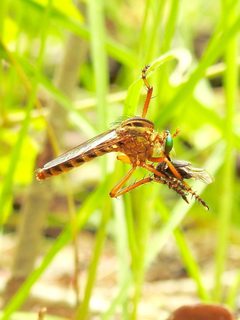
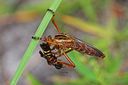
Diogmites properans is a of robber fly in the Asilidae, Dasypogoninae. The Diogmites comprises approximately 26 species distributed primarily in the Americas. Members of this genus are commonly known as "hanging thieves" due to their distinctive of suspending from vegetation by their front legs while manipulating prey with the remaining legs.
Pronunciation
How to pronounce Diogmites properans: /diːˈɒɡmɪtiːz ˈprɒpərənz/
These audio files are automatically generated. While they are not always 100% accurate, they are a good starting point.
Identification
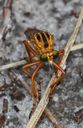
Members of the Diogmites are distinguished from other robber fly genera by their characteristic "hanging thief" —suspending from vegetation by their forelegs while feeding. They possess a relatively slender body form compared to some other large asilids. Specific identification of D. properans requires examination of morphological details including genitalia; the was described by Bromley in 1936. Within the genus, species are distinguished by details of abdominal coloration, leg coloration, and male genitalic structure.
Images
Distribution
The occurs in North America. The Diogmites is primarily distributed in the Americas, with most species occurring in the Nearctic and Neotropical regions.
Behavior
Members of the Diogmites are known for their distinctive "hanging thief" , whereby they suspend from vegetation by their front or middle legs while manipulating prey with the remaining legs. This behavior is a hallmark of the genus and has been well-documented in related such as Diogmites neoternatus.
Ecological Role
As a member of the Asilidae, D. properans functions as an aerial of other insects. Robber flies are predators that capture flying insects in mid-air, contributing to the regulation of insect in their .
Human Relevance
Robber flies including Diogmites are beneficial insects that prey on other insects, including some potential pests. They do not bite humans unless handled or trapped against skin. The has been featured in entomological literature and photography due to its distinctive behavioral traits.
Similar Taxa
- Diogmites neoternatusAnother large in the same with similar "hanging thief" ; distinguished by specific details of coloration and size (D. neoternatus is noted as one of the largest robber flies with striking green )
- Other Dasypogoninae genera (e.g., Microstylum)Similar large size and predatory habits, but Microstylum lack the distinctive hanging and have different mystax structure (confined to oral margin with stout bristles)
- Promachus speciesSimilar large size and predatory , but Promachus are generally more robust, lack the hanging thief behavior, and have different abdominal coloration patterns
More Details
Taxonomic History
The was described by S.W. Bromley in 1936. Bromley was a prominent dipterist who produced significant works on the Laphriinae and other Asilidae .
Genus Diversity
The Diogmites contains approximately 26 , with greatest diversity in the Neotropical region. The genus is part of the Dasypogoninae, which is one of the major lineages within the Asilidae.
Sources and further reading
- BugGuide
- Wikipedia
- GBIF taxonomy match
- iNaturalist taxon
- Catalogue of Life
- T.G.I.Flyday – Andrenosoma fulvicaudum | Beetles In The Bush
- T.G.I.Flyday | Beetles In The Bush
- Bug Eric: Robber Flies
- Arkansas | Beetles In The Bush | Page 3
- Asilidae | Beetles In The Bush | Page 2
- July | 2011 | Beetles In The Bush | Page 2