
Diogmites neoternatus
(Bromley, 1931)
Plain-tailed Hanging Thief
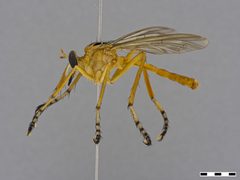
Diogmites neoternatus is a of robber fly in the Asilidae, commonly known as the Plain-tailed Hanging Thief. It is notable for its large size and striking green , making it one of the most charismatic species among North American robber flies. The species exhibits the distinctive 'hanging thief' characteristic of its : swinging from its forelegs while consuming prey. It belongs to the Dasypogoninae and is widely distributed across eastern North America.
Pronunciation
How to pronounce Diogmites neoternatus: /ˌdaɪ.əɡˈmaɪtiːz ˌniː.oʊˈtɜːrnətəs/
These audio files are automatically generated. While they are not always 100% accurate, they are a good starting point.
Identification
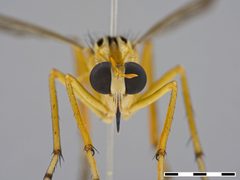
Distinguished from other Diogmites by its plain, unmarked or lightly marked (hence 'neoternatus,' meaning 'newly marked' or referring to reduced patterning). The species is recognized by its large size, prominent green , and relatively plain abdominal coloration compared to with more boldly patterned abdomens. As with other members of the , it possesses the deep concave vertex between the eyes typical of Asilidae and a bearded with stout mystax bristles.
Images
Distribution
Eastern North America. The occurs broadly across the eastern United States, with records from multiple states in the region. Specific range boundaries are not precisely documented in available sources.
Diet
; preys on other insects. Like other robber flies, it is an opportunistic that captures flying insects in mid-air. Specific prey preferences have not been documented for this .
Life Cycle
Complete with , larva, pupa, and stages. Larval is poorly known; other Dasypogoninae larvae are presumed to be in soil or decaying organic matter, but specific details for D. neoternatus are unrecorded.
Behavior
Exhibits the characteristic 'hanging thief' of the Diogmites: capturing prey and then hanging suspended by its forelegs while manipulating and consuming the prey with its remaining legs. This distinctive feeding posture is the source of both the genus name and the 'hanging thief.' are swift aerial that intercept flying insects in mid-air.
Ecological Role
Apex in insect ; regulates of other flying insects. As a large, active predator, it likely plays a significant role in controlling prey populations within its .
Human Relevance
No direct economic importance. Like other robber flies, it does not bite humans unless handled and poses no transmission risk. Its impressive appearance makes it a subject of interest for entomologists and nature photographers.
Similar Taxa
- Diogmites angustipennisAnother large eastern North American Diogmites ; distinguished by wing shape and abdominal patterning details
- Microstylum morosumSimilar large size and green , but belongs to Dasypogoninae (not Leptogastrinae); lacks the hanging thief and has different body proportions with more elongated
- Promachus hineiAnother large eastern robber fly with green , but in Asilinae; more robust build and different prey capture without the hanging posture
More Details
Etymology
The name Diogmites refers to the peculiar habit of hanging by the forelegs while consuming prey. The specific epithet neoternatus refers to the relatively plain, newly or lightly marked abdominal pattern compared to other in the genus.
Taxonomic History
Originally described as Deromyia neoternatus by Bromley in 1931, later transferred to Diogmites. The was among those highlighted by MacRae (2011) as exemplifying the impressive size and striking appearance that make certain robber flies particularly charismatic.
Sources and further reading
- BugGuide
- Wikipedia
- GBIF taxonomy match
- iNaturalist taxon
- NCBI Taxonomy
- Catalogue of Life
- T.G.I.Flyday – Andrenosoma fulvicaudum | Beetles In The Bush
- T.G.I.Flyday | Beetles In The Bush
- Arkansas | Beetles In The Bush | Page 3
- Asilidae | Beetles In The Bush | Page 2
- July | 2011 | Beetles In The Bush | Page 2
- Bug Eric: Robber Flies