
Promachus bastardii
(Macquart, 1838)
false bee-killer
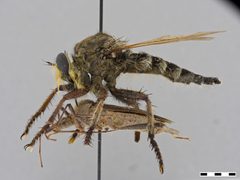
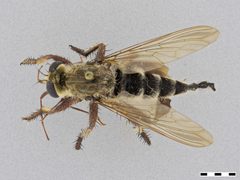
Promachus bastardii, commonly known as the false -killer, is a of robber fly in the Asilidae. Like other members of the Promachus, it is a large, conspicuous that hunts flying insects. The species is part of the 'tiger-striped' group of Promachus species characterized by yellow and black abdominal patterning. It is widely distributed in eastern North America and frequently observed in open such as glades and prairies.

Pronunciation
How to pronounce Promachus bastardii: //prəˈmeɪkəs bæsˈtɑːrdɪ.aɪ//
These audio files are automatically generated. While they are not always 100% accurate, they are a good starting point.
Identification
Promachus bastardii belongs to a group of three 'tiger-striped' Promachus in the eastern United States, distinguished by yellow and black abdominal striping. Specific diagnostic features separating it from the closely related P. hinei and P. rufipes are not documented in available sources. As with other Promachus species, it is a large, robust fly with a prominent mystax (beard of bristles) on the , large , and strong spiny legs adapted for capturing prey in .
Images
Habitat
Observations indicate association with open, sunny including glades, prairies, and similar environments where flying insect prey is abundant. These areas provide the open airspace necessary for aerial hunting typical of large robber flies.
Distribution
Eastern North America. The has been documented across a broad range in the eastern United States, with over 2,000 observations recorded on iNaturalist indicating established throughout this region.
Behavior
As with other Promachus , individuals are known to be fearless capable of capturing flying insects regardless of size. They perch on exposed surfaces and ambush passing prey, seizing them in with spiny legs.
Ecological Role
Aerial occupying the upper of insect in open . Helps regulate of flying insects including bees, , and other dipterans.
Human Relevance
Contributes to natural of flying insects. Occasionally mistaken for bees or due to size and coloration, but is harmless to humans unless handled. Valued subject for macrophotography due to striking appearance and predatory .
Similar Taxa
- Promachus hineiOverlapping distribution and similar 'tiger-striped' abdominal pattern. P. hinei has reddish versus black in P. rufipes, but separation from P. bastardii requires additional characters not specified in available sources.
- Promachus rufipesAnother 'tiger-striped' eastern ; more southeastern in distribution with black distinguishing it from P. hinei. Specific differences from P. bastardii not documented in available sources.
- Promachus vertebratusNorthern 'tiger-striped' distinguished by larger dark areas dorsally on abdominal segments and distinctly contrasting two-toned legs. Distribution and specific markings separate it from other members of this group.
More Details
Nomenclature
The specific epithet 'bastardii' honors an individual, following the Latinized possessive form common in 19th-century . The 'false -killer' distinguishes it from other large robber flies with similar common names.
Taxonomic Note
The three 'tiger-striped' Promachus (P. bastardii, P. hinei, P. rufipes, P. vertebratus) form a challenging identification group in the eastern United States. Reliable field identification to species level may require examination of leg coloration, abdominal pattern details, and geographic context.