
Mallophora leschenaultii
Macquart, 1838
Belzebul bee-eater, Black bee killer, Beelzebub Bee-eater
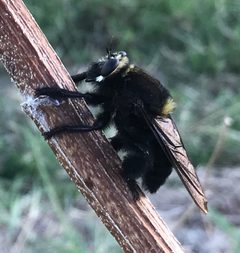
Mallophora leschenaulti is a large robber fly in the Asilidae, commonly known as the belzebul -eater or black bee killer. It is a notable mimic, using its hairy appearance to resemble its hymenopteran prey. The has been documented from the southern United States through Mexico and into South America as far south as Argentina. It is an active of bees and other insects.
Pronunciation
How to pronounce Mallophora leschenaultii: /mæloʊˈfɔːrə lɛʃəˈnɔːlti/
These audio files are automatically generated. While they are not always 100% accurate, they are a good starting point.
Identification
Distinguished from other -mimicking robber flies by the thin terminal segment of the . The similar Laphria, which also contains effective bumble bee mimics, has thick antennae. Mallophora are also described as hairier than Laphria. The combination of large size, black coloration with dense hair, and antennal structure allows separation from other genera.
Images
Appearance
A large, robust robber fly with dense hair covering much of the body, giving it a -like appearance. The body is predominantly black. The have a thin terminal segment, distinguishing it from the similar Laphria which has thick antennae. The are large and prominent. Size is substantial relative to other robber flies, though exact measurements are not well documented in available sources.
Habitat
Associated with open including grasslands, prairies, and glades. In the United States, it occurs in regions with suitable open terrain for hunting flying insect prey.
Distribution
Documented from Texas and Mexico regularly; reported north to Colorado and south to Argentina. GBIF records indicate presence in multiple Brazilian states including Bahia, Espírito Santo, Minas Gerais, Mato Grosso do Sul, Mato Grosso, Pará, Rio de Janeiro, and Rio Grande do Sul.
Diet
Predatory, feeding on bees and other insects. The '-eater' and 'bee killer' reflect its documented on bees.
Behavior
An active aerial that captures prey in . Like other robber flies, it likely perches on vegetation or other elevated surfaces to scan for passing prey. Individuals have been observed to be wary and difficult to approach closely.
Ecological Role
Apex aerial in its , controlling of bees and other flying insects. As a large robber fly, it occupies a significant position in of open grassland and glade .
Human Relevance
May impact local , including honey bees, due to its predatory habits. Its mimicry can lead to misidentification by observers. The is of interest to entomologists and insect photographers due to its size and mimicry.
Similar Taxa
- LaphriaAlso contains effective mimics; distinguished by thick (vs. thin terminal segment in Mallophora) and generally less hairy body
- PromachusLarge robber flies but lack the dense hair and mimicry of Mallophora
- Microstylum morosumNorth America's largest robber fly but occurs in different geographic region (Great Plains) and lacks mimicry, having a streamlined, nearly hairless body
More Details
Nomenclature Note
The epithet is sometimes spelled 'leschenaultii' (with two i's) in some sources including GBIF, reflecting the original spelling by Macquart in 1838. The spelling 'leschenaulti' is also widely used.
Etymology
The 'belzebul -eater' or 'Beelzebub Bee-eater' references Beelzebub, a name associated with flies in historical and biblical contexts, alluding to the ' impressive size and predatory nature.