
Machimus notatus
(Wiedemann, 1828)
Black-thighed Bladetail
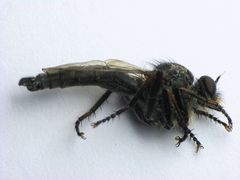
Machimus notatus is a of robber fly in the Asilidae, commonly known as the Black-thighed Bladetail. As a member of the predatory asilid flies, it hunts other insects in . The species has been documented in the northeastern United States, including Vermont.
Pronunciation
How to pronounce Machimus notatus: /ˈmɑ.kɪ.mʊs noʊˈtæ.tʊs/
These audio files are automatically generated. While they are not always 100% accurate, they are a good starting point.
Identification
The "Black-thighed Bladetail" suggests distinctive dark coloration on the hind or tibiae, a feature that may help distinguish this from . Specific diagnostic characters for Machimus notatus require examination of morphological details such as leg coloration pattern and terminalia structure.
Images
Distribution
Documented from the northeastern United States, specifically Vermont. GBIF records indicate occurrence in the US with a specific record from Vermont-US.
Diet
As a robber fly, Machimus notatus is an aerial that captures other insects in . Specific prey records for this have not been documented.
Behavior
Typical of robber flies, this likely perches on vegetation or bare ground to ambush flying insect prey. Hunting involves rapid to intercept prey, followed by capture using spiny legs and immobilization with a .
Ecological Role
As a predatory insect, this contributes to of other flying insects within its .
Similar Taxa
- Other Machimus species share general robber fly and may occur in sympatry; leg coloration patterns and genitalic structures are typically required for definitive identification.
- Other AsilidaeMany robber fly share similar body plans and predatory habits; examination of specific morphological characters is necessary for identification to and species.
More Details
Taxonomic note
The was described by Wiedemann in 1828. It is classified in the tribe Machimini within the Asilinae.