
Latheticus oryzae
Waterhouse, 1880
Long-Headed Flour Beetle
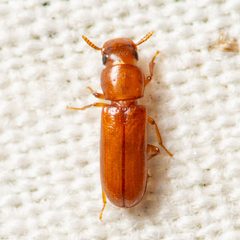
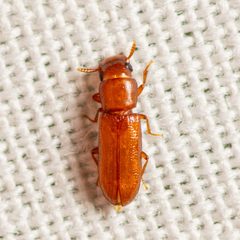
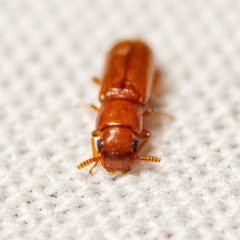
Latheticus oryzae is a small stored-product pest in the Tenebrionidae, commonly known as the long-headed . It infests milled grain products, cereals, flour, and rice, with both and larvae feeding directly on these substrates. The is notable for its elongated and resemblance to Tribolium castaneum. It has been documented in high-temperature environments including Chinese baijiu-producing regions, where it infests fermented Daqu starter cultures.
Pronunciation
How to pronounce Latheticus oryzae: //læˈθɛtɪkəs ɔˈraɪziː//
These audio files are automatically generated. While they are not always 100% accurate, they are a good starting point.
Identification
Distinguished from Tribolium castaneum by its elongated, protruding and more slender body form. The distinctive head shape is the primary diagnostic feature separating it from similar stored-product tenebrionids.
Images
Habitat
Stored grain facilities, food processing environments, and fermented product storage areas. Documented in high-temperature environments such as Chinese baijiu-producing regions where it infests Daqu starter cultures maintained at approximately 30°C with 60% humidity.
Distribution
Widely distributed as a stored-product pest; documented occurrences include Serbia, Albania, Austria, and Belgium. Collected from Moutai Town, Guizhou Province, China (27°51′ N, 106°22′ E). Distribution is human-mediated through commerce in grain products.
Diet
Wheat, rice, cereals, flour, packaged foods, and rice products. Both and larvae feed on milled grain products and can establish as secondary in stored grains. Documented feeding on fermented Daqu starter cultures in Chinese baijiu production facilities.
Host Associations
- wheat - food sourcemilled products
- rice - food sourcegrains and rice products
- Daqu starter cultures - food sourcesauce-flavor fermented products in baijiu production
Life Cycle
Development includes , larval, pupal, and stages. Documented developmental stages in laboratory colonies: early larvae (1 day old), late larvae (last instar), early pupae (1 day old), late pupae (5 days old), and 1-day-old adults. Developmental rate varies with temperature and humidity conditions.
Behavior
Both larvae and feed directly on infested materials. Shows remarkable adaptability to high-temperature environments. Laboratory studies indicate developmental and tissue-specific differences in mitochondrial , with elevated energy metabolism genes in larval stages and , potentially reflecting adaptations to nutrient-rich environments.
Ecological Role
Significant pest of stored grains and grain products causing yield losses. Economic impact on stored grain systems and fermented product industries. Functions as a secondary pest that can establish in already-damaged or processed grain products.
Human Relevance
Economic pest of stored food products. Infests cereals, flour, rice, and packaged foods in storage and processing facilities. Documented impact on Chinese baijiu production through of Daqu starter cultures. Management requires proper storage in sealed containers.
Similar Taxa
- Tribolium castaneumSimilar size, coloration, and stored-product ; distinguished by L. oryzae's elongated protruding and more slender body
- Tribolium confusumOverlaps in and food preferences; distinguished by and body proportions
More Details
Mitochondrial genome
Complete mitochondrial sequenced (15,798 , GenBank PX331584.1) with typical insect mitogenome structure: 13 protein-coding genes, 22 tRNAs, 2 rRNAs, and control region. A+T content of 71.08%. Phylogenetic analysis places L. oryzae as sister to Tribolium within tribe Tenebrionini.
Sources and further reading
- BugGuide
- Wikipedia
- GBIF taxonomy match
- iNaturalist taxon
- NCBI Taxonomy
- Oh, the Bugs They Saw at the Bohart! | Bug Squad
- graphical abstract example - Entomology Today
- Bug Eric: Merchant Grain Beetle
- New Meta-Analysis Examines How Landscape Fire Smoke Affects Insects
- Graphical Abstracts: Where to Find Illustration and Design Help for Your Next Paper
- The effect of light on the life cycle of Latheticus oryzae Waterhouse (Coleoptera, Tenebrionidae)
- Developmental biology of field and laboratory populations of Latheticus oryzae Waterhouse (Coleoptera, Tenebrionidae) under various conditions of temperature and humidity
- The Complete Mitochondrial Genome of the Pest Beetle Latheticus oryzae: Assembly, Annotation, and Phylogenetic Analysis.