
Bolitophagus
Illiger, 1798
Species Guides
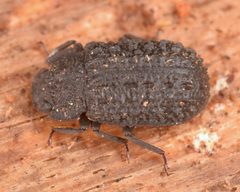
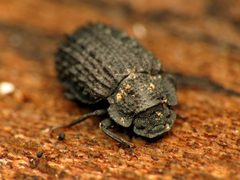
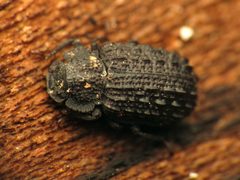
1Bolitophagus is a of darkling beetles (Tenebrionidae) described by Illiger in 1798. The genus occurs across Eurasia and North America. The best-studied , Bolitophagus reticulatus, is a saproxylic that develops exclusively in fruiting bodies of the wood-decaying fungus Fomes fomentarius.
Pronunciation
How to pronounce Bolitophagus: //ˌboʊ.lɪˈtæf.ə.ɡəs//
These audio files are automatically generated. While they are not always 100% accurate, they are a good starting point.
Identification
Distinguished from related by association with polypore fungi, particularly Fomes fomentarius. Bolitophagus reticulatus has a reticulated (net-like) sculpturing on the . are typically dark-colored beetles found on or near bracket fungi on dead or dying broadleaf trees. Separation from the threatened Oplocephala haemorrhoidalis requires careful examination; B. reticulatus is more common and shows greater willingness.
Images
Habitat
Primordial and old-growth forests; managed forests with sufficient dead wood. Specifically associated with trees bearing fruiting bodies of Fomes fomentarius. Occurs on standing or fallen trunks that are relatively thick and carry abundant sporocarps. Prefers where trunks touch the ground only partially. Found at elevations around 1,000 m in montane old-growth beech forests.
Distribution
Palearctic region and North America. In Europe, shows fragmented distribution in the Alpine region. Confirmed occurrences include Scandinavia, Montenegro (Biogradska Gora National Park, Dinaric Alps), and across temperate broadleaf forest zones. Molecular evidence indicates postglacial expansion from refugia south of the Great Caucasus, with potential additional refugia at the Pyrenees foothills and in the Balkan region.
Seasonality
period restricted almost entirely to one week during summer. have been observed in October in Montenegro.
Diet
Fungivorous; feeds on fruiting bodies of Fomes fomentarius. Both larvae and consume fungal tissue. Pairs of male and female beetles prefer living fungus tissue, while single beetles prefer dead fungus.
Host Associations
- Fomes fomentarius - obligatoryMonophagous; all life stages develop exclusively in fruiting bodies of this polypore fungus. More abundant on fruiting bodies growing on birch than on beech.
- Fagus sylvatica - associatedEuropean beech; tree for F. fomentarius supporting B. reticulatus
- Fagus orientalis - associatedOriental beech; tree in Caucasus region
- Betula - associatedBirch; tree for F. fomentarius. Fruiting bodies on birch support higher densities than those on beech
Life Cycle
Complete with , larval, pupal, and stages. All developmental stages occur within fruiting bodies of Fomes fomentarius. Adults can survive for up to three winters, with minimum yearly survival rate estimated at 0.20.
Behavior
Strong preference for large bracket fungi over small ones and over loose bark ; this habitat selection is linked to survival advantage. Attracted to ethanol and to combinations of ethanol with fruiting body volatiles. willingness is high; individuals make several mostly shorter flights rather than few long flights. Long-distance is difficult to observe but appears effective when it occurs; short-distance movements are more frequent.
Ecological Role
Saproxylic contributing to decomposition and mineralization of wood in forest . As a mycetophilic , facilitates nutrient cycling through consumption of fungal tissue and interaction with wood-decay processes. Together with fungi, contributes to decomposition in temperate broadleaf forests.
Human Relevance
Used as a model organism for studying saproxylic , requirements, and responses to forest management. Not included in the IUCN Red List for saproxylic beetles. Presence indicates old-growth forest conditions and habitat continuity. Threatened relative Oplocephala haemorrhoidalis is sometimes confused with B. reticulatus in conservation assessments.
Similar Taxa
- Oplocephala haemorrhoidalisCongeneric tenebrionid also associated with Fomes fomentarius. Distinguished by being rarer and threatened; has fewer but larger , lower proportion of individuals with developed muscles, lower flight willingness, and tendency to make few long flights rather than many short ones. Requires sites with high of suitable substrates available continuously for long periods.
More Details
Genetic structure
Mitochondrial and microsatellite data show only marginal genetic differentiation across most of Europe, consistent with high mobility and recent postglacial expansion. Significant genetic split exists between Caucasus and European , indicating separate glacial refugium south of the Great Caucasus with contact zone in Crimea.
Microbiome
Bacterial associated with larvae and are dominated by Proteobacteria, Actinobacteria, and Bacteroidetes. Microbiome composition clusters primarily by developmental stage rather than by tree .
Sources and further reading
- BugGuide
- Wikipedia
- GBIF taxonomy match
- iNaturalist taxon
- NCBI Taxonomy
- Catalogue of Life
- Survival and habitat preferences of adult Bolitophagus reticulatus
- The saproxylic beetle Bolitophagus reticulatus : its frequency in managed forests, attraction to volatiles and flight period
- Further finding of Bolitophagus reticulatus (Linnaeus, 1767) in Montenegro (Coleoptera: Tenebrionidae) with brief comments on its distribution and conservation
- Molecular biogeography of the fungus-dwelling saproxylic beetle Bolitophagus reticulatus indicates rapid expansion from glacial refugia
- Fungus-infected trees as islands in boreal forest: Spatial distribution of the fungivorous beetle Bolitophagus reticulatus (Coleoptera, Tenebrionidae)
- Colonisation ability of the threatened tenebrionid beetle Oplocephala haemorrhoidalis and its common relative Bolitophagus reticulatus
- The importance of scale and spatial variables for the fungivorous beetle Bolitophagus reticulatus (Coleoptera, Tenebrionidae) in a fragmented forest landscape
- The microbiome profiling of fungivorous black tinder fungus beetle Bolitophagus reticulatus reveals the insight into bacterial communities associated with larvae and adults
- Peer Review #2 of "The microbiome profiling of fungivorous black tinder fungus beetle Bolitophagus reticulatus reveals the insight into bacterial communities associated with larvae and adults (v0.1)"
- Peer Review #1 of "The microbiome profiling of fungivorous black tinder fungus beetle Bolitophagus reticulatus reveals the insight into bacterial communities associated with larvae and adults (v0.2)"
- Peer Review #1 of "The microbiome profiling of fungivorous black tinder fungus beetle Bolitophagus reticulatus reveals the insight into bacterial communities associated with larvae and adults (v0.1)"
- Peer Review #3 of "The microbiome profiling of fungivorous black tinder fungus beetle Bolitophagus reticulatus reveals the insight into bacterial communities associated with larvae and adults (v0.2)"
- Peer Review #3 of "The microbiome profiling of fungivorous black tinder fungus beetle Bolitophagus reticulatus reveals the insight into bacterial communities associated with larvae and adults (v0.1)"