
Strongylium hemistriatum
Triplehorn & Spilman, 1973
Strongylium hemistriatum is a of darkling beetle in the Tenebrionidae, Stenochiinae. The Strongylium is currently under taxonomic revision. This species was described by Triplehorn and Spilman in 1973. Members of this genus are often found on tree trunks in tropical and subtropical regions.
Pronunciation
How to pronounce Strongylium hemistriatum: //strɒnˈɡɪliəm ˌhɛm.ɪˈstraɪ.eɪ.təm//
These audio files are automatically generated. While they are not always 100% accurate, they are a good starting point.
Identification
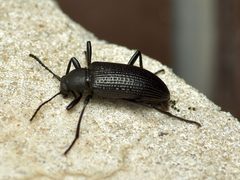
The Strongylium can be recognized by its elongate body form and long-jointed , traits that formerly led some to be classified in the separate Lagriidae. Species-level identification within Strongylium requires examination of subtle morphological characters and is best confirmed by familiar with the genus. The bright green coloration of the and pronotum has been noted in some specimens, though this trait alone is insufficient for species-level .
Images
Habitat
Has been observed on tree trunks in urban and forested areas. The occurs in tropical and subtropical environments.
Distribution
South America. Specific locality records include São Paulo State, Brazil. The broader distribution of the within South America remains incompletely documented.
Seasonality
Observed in January in southeastern Brazil, suggesting activity during the austral summer.
Behavior
Exhibits rapid escape when disturbed; specimens have been observed dropping from tree trunks when approached.
Similar Taxa
- Strongylium haemorrhoidaleClosely related within the same ; morphological similarity requires careful examination for differentiation
- Lagriinae (subfamily)Formerly treated as Lagriidae, these beetles share the elongate body and long-jointed that characterize Strongylium, but are now classified within Tenebrionidae
More Details
Taxonomic revision
The Strongylium is currently undergoing revision by Enrico Ruzzier and colleagues. boundaries and diagnostic characters may be clarified in forthcoming publications.
Identification challenges
This exemplifies the difficulty of identifying tenebrionid beetles from photographs alone. Despite distinctive coloration in some specimens, species-level identification often requires examination of genitalia and other microscopic characters.