
Upis ceramboides
(Linnaeus, 1758)
Roughened Darkling Beetle, kökskörven
Upis ceramboides is a fire-dependent darkling beetle that colonizes burned deciduous trees, particularly birch. The has declined in southern Sweden due to fire suppression and modern forestry, persisting mainly in northern Scandinavia, Alaska, and Canada. exhibit extreme freeze , surviving temperatures well below freezing through unique biochemical adaptations including xylomannan antifreeze and threitol. Larvae develop in fire-damaged inner bark rich in fungal mycelia, with a two-to-three-year .
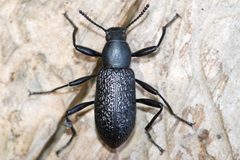
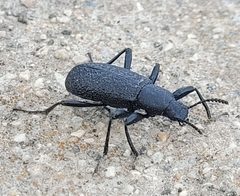
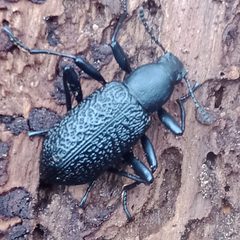
Pronunciation
How to pronounce Upis ceramboides: /ˈuːpɪs sɛrˌæmˈbɔɪdiːz/
These audio files are automatically generated. While they are not always 100% accurate, they are a good starting point.
Identification
Distinguished from other darkling beetles by its strict association with fire-damaged wood and its holarctic distribution. The combination of (burned birch and other deciduous trees) and geographic range separates it from similar tenebrionids. are reportedly found indoors when firewood is burned in winter in parts of Sweden, a behavioral clue to identification.
Images
Habitat
Fire-damaged forests, specifically beneath the bark of burned deciduous trees. Primary is birch (Betula), with occasional occurrence on willow and aspen. Larvae inhabit inner bark rich in fungal mycelia and extend into sapwood.
Distribution
Holarctic distribution: northern Sweden (Västerbotten and Norrbotten provinces), Alaska, and Canada (Alberta, British Columbia, Manitoba, New Brunswick). Formerly present in southern Sweden but now locally extirpated there.
Seasonality
are active and reproduce in spring. occurs during summer months under bark. Adults are the stage, with freeze enabling survival through winter. In Vindeln municipality, Sweden, adults have been observed indoors during winter when firewood is burned.
Diet
Larvae feed on inner bark and sapwood of fire-damaged trees, specifically tissues rich in fungal mycelia. The role of fungal material versus wood tissue in nutrition has not been precisely determined.
Host Associations
- Betula - primary Fire-damaged birch is the main substrate for larval development
- Salix - occasional Willow recorded as secondary tree
- Populus tremula - occasional Aspen recorded as secondary tree
Life Cycle
Larvae develop in inner bark and sapwood over two to three years. occurs during summer months beneath bark. emerge and reproduce the following spring. Adults are the life stage, with documented seasonal physiological changes that enhance freezing .
Behavior
demonstrate extreme freeze , surviving temperatures well below freezing. This tolerance involves seasonal physiological plasticity, with adults acquiring enhanced cold hardiness prior to winter. Biochemical mechanisms include xylomannan (a polysaccharide- complex) and the sugar alcohol threitol. Adults occasionally enter human dwellings when infested firewood is burned indoors.
Ecological Role
Colonizer of post-fire ; functions as part of the early successional in burned forests. Larval feeding in fire-damaged wood contributes to wood decomposition. Dependent on forest fire regimes for habitat creation.
Human Relevance
Considered vulnerable to extinction due to fire suppression and modern forestry practices. In Vindeln municipality, Sweden, known colloquially as "kökskörven" due to its habit of appearing indoors when firewood is burned in winter. Subject of physiological research on natural freeze mechanisms.
Similar Taxa
- Cucujus clavipes puniceusAnother freeze-tolerant sharing extreme cold survival adaptations; both have been studied for natural antifreeze mechanisms but differ in (Cucujidae vs. Tenebrionidae) and associations
- Polypedilum vanderplankiAnother notable freeze-tolerant mentioned alongside U. ceramboides in literature, though it is a rather than a , with entirely different and
More Details
Conservation Status
Classified as vulnerable; decline attributed to lack of fire-damaged forests and birch, combined with modern forestry practices that suppress natural fire regimes and remove dead wood
Biochemical Adaptations
Xylomannan, a non-protein antifreeze molecule composed of polysaccharide and , was identified in this . The sugar alcohol threitol also contributes to freeze . These adaptations allow survival at temperatures well below freezing as an strategy