
Edrotes rotundus
(Say, 1824)
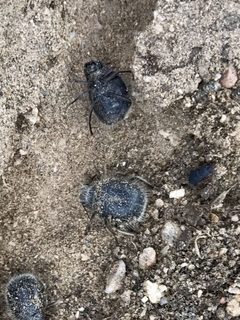
Edrotes rotundus is a of darkling beetle in the Tenebrionidae. It is native to North America and has been documented in the southwestern United States and Mexico. The Edrotes is characterized by small, rounded body forms adapted to arid environments. Records from Colorado represent range extensions beyond the species' previously documented distribution.
Pronunciation
How to pronounce Edrotes rotundus: /ɛdˈrotɛs roʊˈtʌndəs/
These audio files are automatically generated. While they are not always 100% accurate, they are a good starting point.
Identification
The rounded body form distinguishes Edrotes from many other Tenebrionidae . Within the genus, E. rotundus may be distinguished from by subtle morphological features of the and body proportions, though specific diagnostic characters require examination of specimens. The is most reliably identified through dissection and examination of genitalic structures.
Images
Habitat
Arid and semi-arid environments including sandy areas, dunes, and riparian corridors in desert and grassland regions. In Colorado, it has been found in sandy adjacent to riparian areas.
Distribution
Documented from Mexico (MX), the southwestern United States including Arizona, New Mexico, Texas, Oklahoma, Kansas, and Colorado. The Colorado record from Prowers County represents a northward range extension.
Seasonality
are active during warmer months. In Colorado, observed in mid-May. Activity patterns likely vary geographically with local climate conditions.
Ecological Role
As a darkling beetle, likely contributes to decomposition processes and nutrient cycling in arid . The rounded body form suggests to burrowing in sandy substrates.
Human Relevance
Of minor direct significance to humans. Occasionally encountered by entomologists and naturalists in field surveys. The Colorado discovery was documented by a citizen scientist and represents the value of observational natural history.
Similar Taxa
- Other Edrotes speciesShare the rounded body form and small size; require detailed morphological examination for separation
- Other small Tenebrionidae in sandy habitatsMay occur sympatrically; distinguished by body shape and elytral
More Details
Taxonomic history
Described by Thomas Say in 1824. The Edrotes remains relatively understudied, with limited modern taxonomic revisions.
Collection records
GBIF records indicate presence in Mexico. iNaturalist documents 31 observations. The Colorado record from 2017 appears to be one of few documented occurrences north of the core southwestern range.