
Statira croceicollis
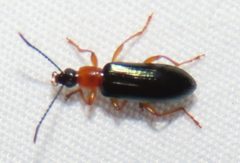
Statira croceicollis is a of darkling beetle in the Tenebrionidae, specifically within the Lagriinae (formerly treated as the separate family Lagriidae). It belongs to a group of beetles commonly referred to as 'long-jointed beetles,' which were relatively recently assimilated into Tenebrionidae. Like other members of its , this species exhibits an aberrant body form that does not resemble 'classic' darkling beetles such as Eleodes.
Pronunciation
How to pronounce Statira croceicollis: /stəˈtɪrə kroʊˌsaɪˈkɔlɪs/
These audio files are automatically generated. While they are not always 100% accurate, they are a good starting point.
Identification
Statira croceicollis can be distinguished from typical darkling beetles by its elongated body form with long, slender legs and —traits characteristic of the Lagriinae . Unlike Eleodes and other familiar tenebrionids, it does not display the robust, rounded body shape or -standing defensive . The name 'croceicollis' (meaning 'saffron-necked') likely refers to a yellowish or orange coloration on the pronotum or head region, though this requires verification from specimens. Members of Statira have antennae with elongated segments that may superficially resemble those of ground beetles (Carabidae), but can be distinguished by concealed beneath the rather than exposed forward-directed jaws.
Images
Similar Taxa
- Statira basalisAnother in the same , sharing the elongated 'long-jointed beetle' and likely similar preferences, distinguished by specific color pattern differences on the body.
- Lagria villosaA related lagriine with similar slender body form and long appendages; Lagria are more commonly encountered in some regions and may be confused with Statira due to shared characteristics.
- Carabidae (ground beetles)Superficially similar due to elongated and active habits, but distinguished by exposed forward-directed , faster running speed, and predatory lifestyle rather than detritivory.
More Details
Taxonomic History
The Statira was formerly placed in the Lagriidae (long-jointed beetles) before taxonomic revision assimilated this group into Tenebrionidae as the Lagriinae. This explains why Statira croceicollis does not conform to popular conceptions of 'darkling beetle' .