
Gnatocerus
Thunberg, 1814
broad-horned flour beetle, horned flour beetle
Species Guides
3- Gnatocerus cornutus(Broadhorned Flour Beetle)
- Gnatocerus guatemalensis
- Gnatocerus maxillosus(flour beetle)
Gnatocerus is a of darkling beetles (Tenebrionidae) established by Carl Peter Thunberg in 1814. The genus is frequently misspelled as "Gnathocerus" due to incorrect assumption that "gnato-" derives from Greek gnatho- (jaw). occur across Europe, Africa, and the Americas. The genus is best known from studies of Gnatocerus cornutus, which serves as a model organism for research on , weapon evolution, and male dimorphism.
Pronunciation
How to pronounce Gnatocerus: //ˌnætəˈsɪərəs//
These audio files are automatically generated. While they are not always 100% accurate, they are a good starting point.
Identification
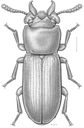
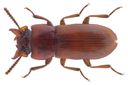
Males distinguished from related flour beetles by combination of enlarged curved , widened gena, and small vertex horns. Females more difficult to identify, lacking obvious diagnostic features; separation from other Tenebrionidae requires examination of genitalia or other subtle morphological characters. The genus name is commonly misspelled "Gnathocerus" in literature.
Images
Appearance
Males possess enlarged, curved used as combat weapons, widened gena (cheek regions), and small horns on the vertex of the . Females lack these exaggerated structures entirely. Body form is typical of flour beetles: elongate, somewhat cylindrical, with hardened forewings () covering the . Mandible size shows continuous variation in males, creating distinct morphs from large-weaponed to small-weaponed individuals.
Habitat
Stored-product environments; specifically associated with grain and flour storage facilities. Natural of wild not well documented.
Distribution
Europe, Africa, and the Americas. Specific countries with records include Colombia, Denmark, Norway, Sweden, and the United States (Vermont).
Diet
Stored grain products; specific dietary components not documented beyond general flour beetle .
Life Cycle
Developmental period varies with male morph: larger males with bigger develop faster than smaller males. Larval and diet quality strongly influences life-history traits and reproductive success.
Behavior
Males engage in aggressive combat using as weapons to gain access to females. Combat involves pushing and lifting opponents. Larger males with bigger mandibles typically win fights. Smaller males exhibit higher locomotion, potentially facilitating to new territories. Fighting occurs in dark environments where visual cues are limited.
Ecological Role
Stored product pest. No documented ecological role in natural .
Human Relevance
Economic pest of stored grain and flour. Widely used as laboratory model organism for studying , weapon evolution, condition-dependent trait expression, and genetic correlations between and .
Similar Taxa
- TriboliumAlso flour beetles in Tenebrionidae; distinguished by lack of male mandibular weapons and horns
- Onthophagini scarab beetlesShare negative correlation between weapon size and size; distinguished by different (Scarabaeidae) and different weapon types (horns vs. )
Misconceptions
The name is frequently misspelled as "Gnathocerus" based on incorrect assumption that "gnato-" derives from Greek gnatho- (jaw). The original spelling Gnatocerus is correct.
More Details
Model organism status
Gnatocerus cornutus has become an important study system for evolutionary research due to ease of laboratory rearing, observable aggressive , and clear in weaponry.
Genetic correlations
Studies have demonstrated significant genetic correlations between size, prothorax length, and fighting success, indicating these traits evolve together rather than independently.
Sources and further reading
- BugGuide
- Wikipedia
- GBIF taxonomy match
- iNaturalist taxon
- NCBI Taxonomy
- Catalogue of Life
- Morphological Traits Relate to Mating Strategies in Male Japanese Stag Beetles
- Genetic correlations between weapons, body shape and fighting behaviour in the horned beetle Gnatocerus cornutus
- Intra-sexual Dimorphism in Male Mandibles and Male Aggressive Behavior in the Broad-Horned Flour Beetle Gnatocerus cornutus (Coleoptera: Tenebrionidae)
- Impacts of diet quality on life‐history and reproductive traits in male and female armed beetle, Gnatocerus cornutus
- Sexually selected traits and life history traits of larger and smaller males of the horned flour beetle Gnatocerus cornutus