
Synchroa
Newman, 1838
synchroa bark beetles
Species Guides
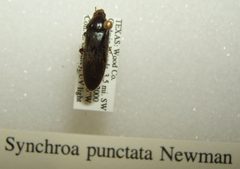
1- Synchroa punctata(Punctate Synchronized Bark Beetle)
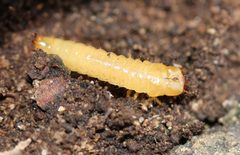
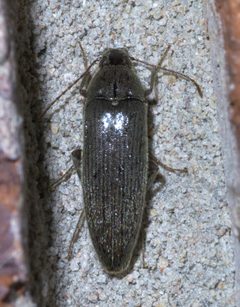
Synchroa is a of beetles in the Synchroidae, comprising approximately six described . Members are characterized by an elongate, tapered, and slightly flattened body with brownish to black coloration. The genus represents the nominal and largest genus within its family, with a broad distribution spanning North America, the eastern Palearctic, and the Oriental regions. is highest in Eastern Asia, where multiple new species have been described in recent decades.
Pronunciation
How to pronounce Synchroa: /ˈsɪŋkroʊə/
These audio files are automatically generated. While they are not always 100% accurate, they are a good starting point.
Identification
Distinguished from superficially similar Melandryidae by larval and unmodified maxillary palpomeres. Within Synchroidae, Synchroa differs from Mallodrya (, North American) and Synchroina (Oriental, two ) by morphology and distribution. Species-level identification relies on male genitalia, particularly paramere shape, and proportions of , , and prothorax.
Images
Appearance
Elongate, tapered, and slightly flattened body. Coloration ranges from brownish to black, often with yellowish decumbent setae. elongated. Prosternal process apically narrowed in some . Body length approximately 16 mm in described species.
Habitat
Montane forest; one collected at 754 m elevation in southeastern Xizang, China. Specific microhabitat requirements are poorly documented.
Distribution
North America; eastern Palearctic region (Russia, Japan, Korea); Oriental region, with highest in Eastern Asia including China (Guangdong, Xizang/Tibet), Vietnam, and Laos.
Similar Taxa
- Melandryidae superficially similar in body form, but distinguished by larval and unmodified maxillary palpomeres in Synchroa.
- SynchroinaBoth in Synchroidae, but Synchroina is restricted to the Oriental region with two , while Synchroa has broader distribution.
- MallodryaBoth in Synchroidae, but Mallodrya is and restricted to North America, whereas Synchroa occurs across multiple biogeographic regions.
More Details
Taxonomic history
Synchroa bark beetles were long treated as members of Melandryidae, but were recognized as an independent by Böving & Craighead (1931), a treatment followed by Crowson (1966).
Species count
Approximately six described , though recent taxonomic work continues to describe new species from China, suggesting the may be more diverse than currently recognized.