
Cephaloon ungulare
LeConte, 1874
false longhorn beetle
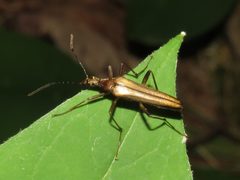
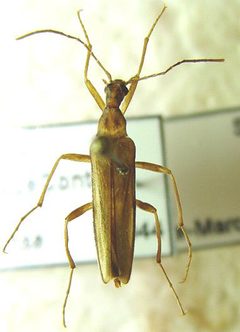
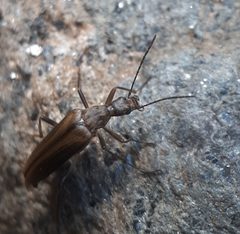
Cephaloon ungulare is a of false longhorn beetle in the Stenotrachelidae, a group of beetles historically placed among longhorn beetles but now recognized as a distinct family. It was described by John Lawrence LeConte in 1874. The species is known from eastern North America, with records from Labrador, New Brunswick, and Newfoundland in Canada. As a member of Stenotrachelidae, it shares the family's characteristic elongated body form and relatively long , though generally shorter than those of true longhorn beetles (Cerambycidae).
Pronunciation
How to pronounce Cephaloon ungulare: /ˈsɛfəloʊ.ɒn ʌŋˈɡjʊˌlɛər/
These audio files are automatically generated. While they are not always 100% accurate, they are a good starting point.
Identification
Cephaloon ungulare can be distinguished from true longhorn beetles (Cerambycidae) by its placement in Stenotrachelidae, which typically possess that are shorter relative to body length than most cerambycids. The Cephaloon is characterized by a somewhat flattened body and distinctive structure. Specific diagnostic features for C. ungulare relative to are not well documented in available sources. Specimens from the type series and verified records are necessary for reliable identification.
Images
Distribution
Eastern North America. Documented from Labrador, New Brunswick, and Newfoundland in Canada. The full extent of its range within North America requires further survey.
Similar Taxa
- Cerambycidae (true longhorn beetles)Stenotrachelidae were historically classified within Cerambycidae and share superficial similarities in body shape, but differ in antennal length proportions and other morphological features.
- Other Cephaloon species within the same would require careful examination of specific morphological characters for separation; C. ungulare is distinguished by features described in the original 1874 description.
More Details
Taxonomic note
NCBI lists the as 'Cephaloidae', but this appears to be an outdated or erroneous entry. Current classification places this in Stenotrachelidae, as confirmed by GBIF and other sources. The family Stenotrachelidae is sometimes referred to as 'false longhorn beetles' or 'narrow-waisted bark beetles'.
Data availability
This has relatively few documented observations (34 records in iNaturalist as of source date), suggesting it may be genuinely uncommon or under-collected. Detailed biological information appears sparse in the accessible literature.