
Scraptiini
Gistel, 1848
Genus Guides
2Scraptiini is a tribe of small beetles within the Scraptiidae, commonly known as false flower beetles. Members are characterized by their compact body form and association with decaying plant material. The tribe was established by Gistel in 1848 and contains multiple distributed across temperate regions. These beetles are part of the superfamily Tenebrionoidea and are often encountered in moist, decaying wood or fungal .
Pronunciation
How to pronounce Scraptiini: //skræpˈtiː.aɪ.naɪ//
These audio files are automatically generated. While they are not always 100% accurate, they are a good starting point.
Identification
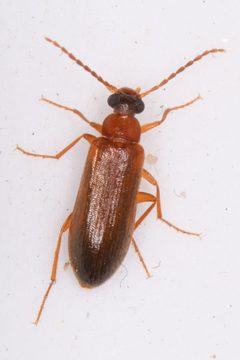
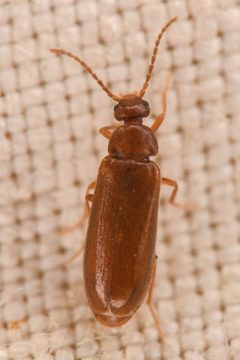
Scraptiini beetles are small, generally 2–5 mm in length, with an elongate-oval to cylindrical body shape. The are typically parallel-sided and may show fine punctation or . are to slightly clubbed, with 11 segments. The pronotum is usually narrower than the base of the elytra and lacks lateral marginal carinae. These features help distinguish them from related tenebrionoid such as Aderidae and Melandryidae, which often have more pronounced antennal clubs or different body proportions.
Images
Habitat
Found in moist, decaying wood, under bark, and in association with fungi. include rotting logs, stumps, and leaf litter in forested areas. Some occur in environments such as compost heaps or stored organic debris.
Distribution
Widespread in the Holarctic region, with records from Europe, Asia, and North America. Distribution extends into northern Africa and parts of the Oriental region. Individual ranges vary, with some showing trans-Palearctic distributions.
Ecological Role
Members of this tribe contribute to decomposition processes in forest by feeding on decaying plant matter and associated fungal growth. They form part of the saproxylic dependent on dead and decaying wood.
Human Relevance
Generally of no direct economic importance. Occasionally found in stored organic materials or compost but not considered pests. May be incidentally collected in forest biodiversity surveys or ecological studies of saproxylic beetles.
Similar Taxa
- AderidaeAderidae (ant-like leaf beetles) share small size and similar but have more strongly clubbed and a distinct pronotal shape with constricted base.
- MelandryidaeMelandryidae (false darkling beetles) overlap in preference but are generally larger with more variable body forms and different tarsal structure.
- Scraptiidae: AnaspidinaeThe other of Scraptiidae, distinguished by more elongate body form and different antennal structure; Anaspidinae is sometimes treated as a separate .
More Details
Taxonomic history
The classification of Scraptiidae has been unstable, with the group historically placed in Melandryidae or treated as a separate . The tribal structure within Scraptiinae remains under study, and the limits of Scraptiini may be revised with further phylogenetic research.