
Scraptiinae
Gistel, 1848
Tribe Guides
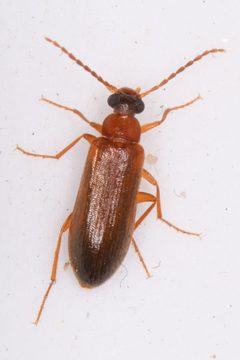
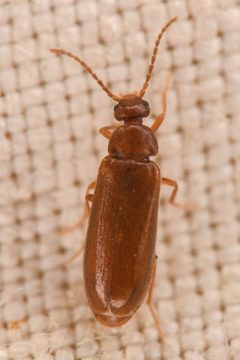
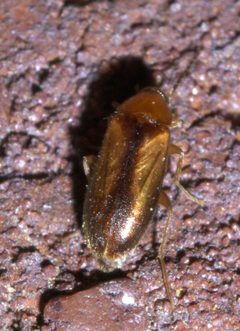
2Scraptiinae is a of beetles in the Scraptiidae, established by Gistel in 1848. Members are commonly known as false flower beetles or scraptiid beetles. The subfamily is distinguished from the other scraptiid subfamily, Anaspidinae, by several morphological features. These beetles are generally small and associated with decaying plant matter and fungal .
Pronunciation
How to pronounce Scraptiinae: //skræpˈtaɪɪniː//
These audio files are automatically generated. While they are not always 100% accurate, they are a good starting point.
Identification
Scraptiinae can be distinguished from Anaspidinae by the presence of a distinct antennal club with three enlarged antennomeres, versus the gradual or weakly clubbed of Anaspidinae. Members of Scraptiinae also tend to have more elongate body forms and less convex compared to Anaspidinae. The prosternal process is narrow and usually does not extend posteriorly between the in Scraptiinae.
Images
Habitat
Found in decaying wood, under bark, in leaf litter, and in association with fungi. Many inhabit moist, shaded environments with abundant decomposing organic matter. Some species have been recorded from flowers, though this is less common than in related .
Distribution
Widespread across the Holarctic region, with records from North America, Europe, and Asia. Distribution extends into the Oriental and Afrotropical regions, though with reduced diversity in tropical areas compared to temperate zones.
Seasonality
are most commonly encountered in spring and summer months in temperate regions. Activity patterns vary by latitude, with some active into autumn in warmer climates.
Diet
Larvae and feed on decaying plant material and fungi. Some have been observed feeding on spores and of basidiomycete fungi.
Life Cycle
Complete with , larva, pupa, and stages. Larvae are elongate and cylindrical, adapted for burrowing in decaying wood and organic substrates. Development time varies by and environmental conditions, with most temperate species having one per year.
Behavior
are often found on vegetation and may be attracted to light. Both larvae and adults are secretive, spending much of their time concealed in decaying substrates. Limited ability has been noted for several .
Ecological Role
Decomposers that contribute to nutrient cycling in forest through consumption of decaying wood and fungal . Serve as prey for various in decaying wood .
Human Relevance
Occasional nuisance pests in stored products, particularly dried plant materials. Some have been recorded from buildings where decaying wood is present. Generally of minor economic importance.
Similar Taxa
- AnaspidinaeOther of Scraptiidae; distinguished by weakly clubbed , more convex body form, and broader prosternal process.
- Mordellidae of similar small beetles; distinguished by hump-backed body shape, pointed , and jumping .
- MelandryidaeRelated in Tenebrionoidea; distinguished by different antennal structure and generally larger size.
More Details
Taxonomic history
The has undergone several revisions, with previously placed in Scraptiinae now transferred to Anaspidinae based on phylogenetic studies.
Fungal associations
Specific fungal relationships remain poorly documented for most , though polypore fungi are frequently mentioned in collection records.