
Ptilophorus wrightii
(LeConte, 1868)
Engineered wedge-shaped Beetle
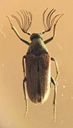
Ptilophorus wrightii is a wedge-shaped beetle in the Ripiphoridae, first described by LeConte in 1868. The was historically known from the southwestern United States (Arizona, New Mexico, Texas) and Mexico, with first records from Colorado and Oklahoma documented in 2014. The specific epithet honors General W.W. Wright, Chief Engineer of the Union Pacific Railway survey during which the species was collected.

Pronunciation
How to pronounce Ptilophorus wrightii: /təˈlɒfərəs ˈraɪti.aɪ/
These audio files are automatically generated. While they are not always 100% accurate, they are a good starting point.
Identification
Distinguished from other Ripiphoridae by the divided : two lobes connected by a slender line of smooth, non-faceted corneous . Females have much less compared to males. The has full-length covering the , unlike many ripiphorids with abbreviated elytra.
Images
Distribution
Colorado, Oklahoma, Arizona, New Mexico, Texas, and Mexico. First records from Colorado and Oklahoma were published in 2014; previously known only from more southwestern localities.
Behavior
Females have been observed ovipositing on dead branches of eastern red-cedar (Juniperus virginiana) and fragrant sumac (Rhus aromatica). During oviposition, females hold their outstretched in a manner not previously documented in beetles.
Similar Taxa
- Toposcopus wrightiiBoth share the specific epithet 'wrightii' and occur in similar southwestern ; however, Toposcopus wrightii belongs to a different within Ripiphoridae and also exhibits divided , requiring careful examination of antennal and body proportions for separation.
Sources and further reading
- BugGuide
- Wikipedia
- GBIF taxonomy match
- iNaturalist taxon
- Grasshoppers of Colorado
- Grasshoppers of Colorado
- My Publications | Beetles In The Bush
- Ripiphoridae | Beetles In The Bush
- Bug Eric: December 2010
- Bug Eric: Moth Monday: Hubbard's Silkmoth
- First records ofPtilophorus wrightii(LeConte 1868) (Coleoptera: Ripiphoridae: Ptilophorinae) in Colorado and Oklahoma, with observations of female behavior