
Ptilophorus
Dejean, 1834
Species Guides
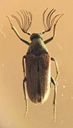
1- Ptilophorus wrightii(Engineered wedge-shaped Beetle)
Ptilophorus is a of wedge-shaped beetles in the Ripiphoridae, comprising at least three described . The genus is characterized by with distinctive — in males and triangular in females—and that fully cover the , a trait unique among Ripiphoridae in some regions. Adult activity occurs primarily in spring, with males exhibiting conspicuous perching and scanning while females seek oviposition sites on dead twigs of living trees. The complete larval remains poorly known, though parasitic development is hypothesized based on family-level characteristics.

Pronunciation
How to pronounce Ptilophorus: //taɪˈlɒfərəs//
These audio files are automatically generated. While they are not always 100% accurate, they are a good starting point.
Images
Habitat
occur in diverse including pine forests, riparian meadows, scrubland, and Mediterranean garrigue with Rosmarinus officinalis, Juniperus, and young Pinus halepensis. Females are found specifically on dead twigs of living trees including Ulmus minor, Juniperus oxycedrus, Rosa, and Fraxinus angustifolia, where they probe bark cracks and wood-boring insect holes for oviposition sites.
Distribution
The has a disjunct global distribution: P. dufourii occurs in the Mediterranean biogeographic region of France (departments 04, 07, 11, 13, 30, 34, 66, 83, 84); P. wrightii is recorded from North America with first records in Colorado and Oklahoma; other are distributed in the Near East, southern Africa, Australia, and Yemen.
Seasonality
activity from late March to early July, peaking late April to late May in Mediterranean .
Life Cycle
stage well-documented; larval development remains unknown. are laid on dead twigs of living trees in bark cracks or wood-boring insect holes, deposited in groups covered with transparent mucus. Eggs measure approximately 870 × 150 µm, translucent white, slightly arched. Females carry roughly 300 eggs. No successful rearing from egg to adult has been completed. Parasitic larval development is hypothesized based on primary larva and characteristics but remains unconfirmed.
Behavior
Males fly and perch at branch or herb apices, expand widely, and rotate and pronotum laterally approximately 180° in a scanning motion resembling radar, then fly to new supports. Females probe dead branches with antennae to locate oviposition sites, inserting the ovipositor into bark cracks for up to 15 minutes. Both sexes rest motionless on small branches with heads tucked ventrally during cold morning temperatures. No mating has been observed despite extensive observation.
Sources and further reading
- BugGuide
- Wikipedia
- GBIF taxonomy match
- iNaturalist taxon
- NCBI Taxonomy
- Catalogue of Life
- My Publications | Beetles In The Bush
- Distribution of Ptilophorus dufourii (Latreille, 1818) in France, with remarks on the behaviour of adults (Coleoptera, Ripiphoridae)
- First records ofPtilophorus wrightii(LeConte 1868) (Coleoptera: Ripiphoridae: Ptilophorinae) in Colorado and Oklahoma, with observations of female behavior