
Mycteridae
Perty, 1840
Palm and Flower Beetles
Genus Guides
3- Hemipeplus
- Lacconotus(palm and flower beetles)
- Mycterus(palm and flower beetles)
Mycteridae is a small of tenebrionoid beetles comprising approximately 30 and 160 distributed worldwide. The family includes three —Mycterinae, Hemipeplinae, and Eurypinae (= Lacconotinae)—which exhibit extreme morphological diversity that complicates family-level of . Species occur across temperate and tropical regions of both hemispheres, with about 20 species in Australia and representatives of three genera (*Mycterus*, *Hemipeplus*, *Lacconotus*) in North America. The family has been recently referred to as "palm and flower beetles" by some authors.
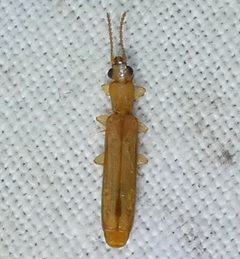
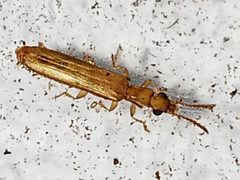
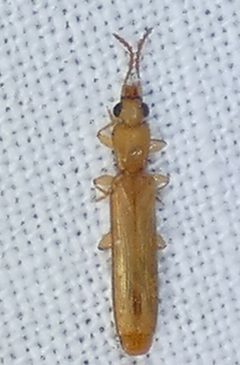
Pronunciation
How to pronounce Mycteridae: /mɪkˈtɛrɪdiː/
These audio files are automatically generated. While they are not always 100% accurate, they are a good starting point.
Identification
Mycteridae are difficult to diagnose at the level due to extreme morphological diversity among the three . The subfamilies Mycterinae, Hemipeplinae, and Eurypinae differ substantially in external structure. Identification to subfamily or typically requires examination of specific structural features rather than general habitus. Larvae are generally flattened in body form.
Images
Habitat
are associated with flowering plants and have been collected by hand from flowers, by net sweeping in meadows and steppe vegetation, and occasionally at light. Larvae typically inhabit spaces between leaves or at the bases of fronds. The includes saproxylic associated with decaying wood of coniferous and deciduous trees. Specific collection include meadows, oak forest edges, steppe vegetation, xerothermic vegetation, and dirt roads.
Distribution
Worldwide distribution with representatives in both Northern and Southern Hemispheres. Documented from: Australia (~20 ); North America ( *Mycterus*, *Hemipeplus*, *Lacconotus*); Bulgaria (Strandzha Mountains, Lyulin Mountains, Eastern Rhodopes, Middle Danubian Plain, Black Sea Coast, Falakro Mountains); Brazil (Rondônia State, Amazonas, Pará, Chapada); Peru (Loreto Department, Madre de Dios Department); Panama (Colón, Panamá, Chiriquí provinces); Rica (Puntarenas, Guanacaste provinces); Ecuador (Napo, Sucumbíos provinces); Bolivia (Santa Cruz Department); Maritime Provinces of Canada (New Brunswick, Nova Scotia, Prince Edward Island); Ukraine (Volyn Region, fossil record).
Diet
Larvae have been observed to consume fungi in their microhabitats between leaves and frond bases. Specific feeding habits are not documented.
Life Cycle
Larval development occurs in association with decaying wood of coniferous or deciduous tree , or in spaces between leaves and at frond bases. emerge and are active in association with flowering plants.
Behavior
are active on flowering plants and are collected by hand from flowers, net sweeping in vegetation, and occasionally occur at light sources. Some show sympatry with cryptic .
Ecological Role
Saproxylic beetles that contribute to decomposition processes in forest . The is part of dead wood-dependent affected by forest management practices.
Human Relevance
The is rarely recorded in regional faunas, suggesting it is undercollected or genuinely uncommon. Forest management practices that reduce dead wood availability may negatively impact saproxylic Mycteridae .
Similar Taxa
- SalpingidaeBoth are small tenebrionoid beetles with saproxylic larvae and are frequently treated together in faunistic surveys; differ in structural details of and mouthparts.
- PythidaeShares saproxylic and tenebrionoid affiliation; differ in body form and specific structural characters, with Pythidae generally more elongate.
- BoridaeAnother small tenebrionoid with saproxylic larvae; differ in antennal structure and body proportions, often co-occurring in dead wood .
More Details
Subfamily diversity
The three Mycterinae, Hemipeplinae, and Eurypinae (= Lacconotinae) are so divergent in appearance that -level characters for identification are difficult to establish. This morphological diversity has complicated the family's taxonomic history.
Taxonomic history
The has no traditional vernacular name; "palm and flower beetles" is a recently coined name not universally adopted. Some were historically misplaced in other families due to the ' divergent morphologies.
Collection methods
Standard collection methods for include hand collecting from flowering plants, sweeping nets through meadow and steppe vegetation, and incidental capture at light traps. Larvae require targeted searching in leaf axils, frond bases, and decaying wood.
Cryptic species
At least one case of cryptic sympatric has been documented: *Hemipeplus quadricollis* and *H. pseudoquadricollis* occur together in some localities and were distinguished only through detailed morphological examination of .
Sources and further reading
- BugGuide
- Wikipedia
- GBIF taxonomy match
- iNaturalist taxon
- NCBI Taxonomy
- Catalogue of Life
- Review of the families Mycteridae, Pythidae and Salpingidae (Coleoptera, Tenebrionoidea) of Bulgaria
- On the paratypes and distribution of Hemipeplus quadricollis Pollock, 1999 (Coleoptera: Mycteridae: Hemipeplinae): does it occur in Peru?
- The Mycteridae, Boridae, Pythidae, Pyrochroidae, and Salpingidae (Coleoptera: Tenebrionoidea) of the Maritime Provinces of Canada
- Revision of Thisiomorphus Pic (Coleoptera: Mycteridae: Eurypinae) with descriptions of eleven new species from Central and South America <br />and a key to genera of Neotropical Eurypinae
- The first fossil Coleoptera record from the Volyn Region, Ukraine, with description of a new Glesoconomorphus (Coleoptera, Mycteridae) in syninclusion with Winterschmidtiidae (Acari) and a key to species.