
Yakuhananomia bidentata
(Say, 1824)
Two-toothed Tumbling Flower Beetle
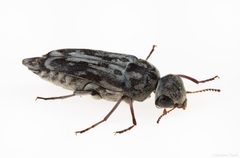
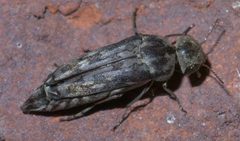
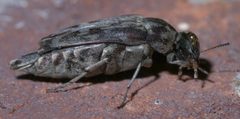
Yakuhananomia bidentata is a of tumbling flower beetle in the Mordellidae, first described by Thomas Say in 1824. It is one of the most frequently observed members of its family in eastern North America, with over 200 citizen science records. The refers to diagnostic morphological features of the species. Like other mordellid beetles, it exhibits the characteristic 'tumbling' escape when disturbed.
Pronunciation
How to pronounce Yakuhananomia bidentata: /jakuːhænəˈnoʊmiə baɪˈdɛntætə/
These audio files are automatically generated. While they are not always 100% accurate, they are a good starting point.
Identification
The specific epithet and 'Two-toothed' refer to two distinct teeth or projections on the hind , a diagnostic feature separating this from . Members of the Yakuhananomia can be distinguished from other North American Mordellidae by their relatively elongate body form and antennal structure. Confirmation of species identity requires examination of the hind coxal .
Images
Habitat
Associated with flowers and vegetation in open ; specific microhabitat preferences have not been documented in detail.
Distribution
Eastern North America. Documented occurrences include the Canadian provinces of New Brunswick, Ontario, and Québec, with broader presence throughout the eastern United States implied by the regional distribution pattern.
Behavior
Exhibits the characteristic tumbling of Mordellidae when disturbed—a rapid, erratic, tumbling movement used as an escape response.
Similar Taxa
- Other Yakuhananomia speciesRequire examination of hind coxal ; Y. bidentata is distinguished by the two teeth on the hind
- Other Mordellidae generaYakuhananomia have elongate bodies and distinctive antennal structure compared to more compact such as Mordella
More Details
Taxonomic history
Described by Thomas Say in 1824, making it one of the earlier described North American mordellid . The Yakuhananomia was established to accommodate species with distinctive morphological features including the characteristic coxal .
Observation frequency
With over 200 iNaturalist observations, this appears to be among the more readily encountered and photographed members of the Mordellidae, likely due to its eastern North American distribution where observer is high.