
Meloe strigulosus
Mannerheim, 1852
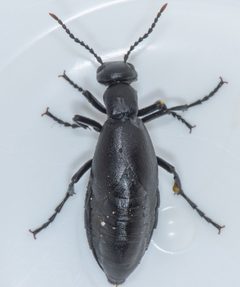
Meloe strigulosus is a blister beetle in the Meloidae, characterized by its phoretic larval involving attachment to other organisms for transport. The has been documented in coastal dune in Oregon, where its ecological relationships have been specifically studied. possess the typical oil beetle with shortened that expose much of the . Like other Meloe species, it produces , a defensive compound toxic to vertebrates.
Pronunciation
How to pronounce Meloe strigulosus: /ˈmɛl.oʊ ˌstrɛɪ.gjuˈloʊ.səs/
These audio files are automatically generated. While they are not always 100% accurate, they are a good starting point.
Identification
As a member of the Meloe, this exhibits the characteristic oil beetle form: robust body with notably short, abbreviated that leave multiple abdominal segments exposed, creating a distinctive 'waistcoat' appearance. The specific epithet 'strigulosus' suggests fine streaking or striation on the body surface, though detailed diagnostic features distinguishing it from are not documented in available sources. Accurate identification to species level within Meloe typically requires examination of genitalic structures and comparison with .
Images
Habitat
Distribution
North America and Central America. Specific documented locations include coastal dunes in Oregon and British Columbia, Canada.
Host Associations
- Ground-nesting bees (Apoidea) - PHORETIC_HOSTLarvae (triungulins) attach to bees for transport to nest burrows; based on -level and specific study of phoretic relationships in this
Life Cycle
Hypermetamorphic with distinct larval phases typical of Meloidae. First-instar larvae (triungulins) are phoretic, attaching to bees to gain access to nest burrows. Subsequent larval instars develop within nests, consuming provisions and host . The specific duration and number of instars for this are not documented.
Behavior
Phoretic in larval stage: triungulins actively seek and attach to organisms (documented as ground-nesting bees in related ) to facilitate transport to suitable developmental sites. This represents an evolutionary to exploit the nesting of solitary bees.
Ecological Role
Nest of ground-nesting bees. As a , larvae consume pollen provisions and , potentially influencing local . The contributes to the complex of nest parasites associated with solitary bee in coastal dune .
Human Relevance
Like all Meloe , possesses in and tissues—a potent blistering agent that can cause dermatitis upon skin contact. The species poses potential risk to livestock if ingested in contaminated hay, though specific incidents are not documented. No direct economic or medicinal uses are recorded for this particular species.
Similar Taxa
- Meloe franciscanusShares coastal dune in western North America and similar phoretic parasitic lifestyle on ground-nesting bees; distinguished by subtle morphological differences in body striation and genitalia
- Other Meloe species members share abbreviated , oil beetle , and -parasitic ; -level identification requires detailed examination of surface sculpturing and male genitalia
More Details
Research significance
The phoretic relationships of M. strigulosus were specifically investigated in a coastal dune in Oregon, contributing to understanding of - dynamics in this system. This study represents one of the few -specific examinations of phoretic in North American Meloe.
Sources and further reading
- BugGuide
- Wikipedia
- GBIF taxonomy match
- iNaturalist taxon
- NCBI Taxonomy
- Meloidae Holdings | Entomology Research Museum
- The Amazing Bee-Parasite Research of Leslie Saul-Gershenz | Bug Squad
- Ground nesting bees beware of blister beetles - Meloe spp. — Bug of the Week
- Blistering beetles - Meloe spp. — Bug of the Week
- Springing into action – oil beetles and citizen science! - Buglife Blog - Buglife
- Phoretic Relationships of the Blister Beetle Meloe (Meloe) Strigulosus Mannerheim (Coleoptera: Meloidae) from a Coastal Dune Habitat in Oregon