
Lytta nuttalli
Say, 1824
Nuttall's blister beetle
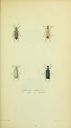
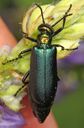
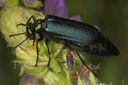
Lytta nuttalli is a North American blister beetle in the Meloidae, first described by Thomas Say in 1824. The specific epithet honors botanist Thomas Nuttall. display brilliant purple and green iridescent coloration. This is notable for its complex involving , with larvae developing as in the nests of solitary bees. Adults are gregarious feeders on legumes and can occasionally damage agricultural crops. are naturally limited by their dependence on native ground-nesting bees for larval development.
Pronunciation
How to pronounce Lytta nuttalli: /ˈlɪtə nʊˈtælaɪ/
These audio files are automatically generated. While they are not always 100% accurate, they are a good starting point.
Identification
Distinguished from similar Lytta by its specific purple-green iridescent coloration and geographic range. May occur in mixed colonies with L. viridana and L. cyanipennis; L. viridana has a shorter period (late May to late June) compared to L. nuttalli (early June to early August). L. cyanipennis flies mid-June to early July. Accurate identification may require examination of male genitalia; the is of the vaginate type typical of the , with seven pairs of muscles and one unpaired muscle associated with the aedeagus and ninth sternum.
Images
Habitat
Native prairie , particularly in areas with abundant leguminous vegetation. commonly found in near bodies of water. Oviposition requires moist, firm soil; desiccate rapidly without moisture. Larval development occurs in nests of solitary ground-nesting bees.
Distribution
Canada: Alberta, Saskatchewan, Manitoba. United States: Idaho south to Arizona, east to Minnesota and New Mexico. Disjunct in eastern California restricted to higher altitudes. Core range centered in the Great Plains and prairie provinces.
Seasonality
period extends from early June to early August. Peak activity occurs during summer months when legumes are in growth. Embryonic development of takes approximately 2-3 weeks at temperatures of 15-30°C, corresponding to normal summer conditions.
Diet
feed primarily on wild legumes, showing preference for cultivated legumes when available. Documented feeding on soybeans, sweetclover, alfalfa, and other legume crops. Will consume non-leguminous plants including Iris, Delphinium, and Brassica , plus sugar beets, oats, barley, and wheat when legumes are scarce. Larvae are , feeding on larvae and stored provisions in nests of solitary bees ( Apidae).
Host Associations
- Megachile sp. - Larvae develop in nests of leafcutter bees; first recorded field observations of Lytta oviposition documented in area with remains of Megachile nesting
- Apidae (solitary bees) - Larvae feed on larvae and food stores in ground-nesting solitary bee nests; natural limited by availability of native ground-nesting bees
Life Cycle
Complex hypermetamorphic development with distinct larval phases. First instar larvae (triungulins) are active and seek out nests. Subsequent instars are parasitic, feeding within bee nests. occurs in host nest or soil. Embryonic development of requires 2-3 weeks at 15-30°C. Eggs are deposited in batches averaging 320 eggs; females produce multiple egg batches. Moisture critical for egg survival—eggs desiccate rapidly without soil contact.
Behavior
are gregarious, feeding in groups on plants. Form mixed colonies with L. viridana and L. cyanipennis. Cross-mating between L. nuttalli and L. viridana occurs in nature, producing hybrids. Both sexes mate multiple times in captivity. Adults prefer moist, firm soil for oviposition. First field observations of oviposition documented for this .
Ecological Role
function as herbivores, consuming legume vegetation and occasionally facilitating nutrient cycling through plant tissue consumption. Larvae act as of solitary bees, potentially regulating . Natural populations are self-limited by bee availability, preventing overexploitation of either host or plant resources.
Human Relevance
Occasional agricultural pest when aggregate on legume crops including soybeans, alfalfa, and sweetclover. Poisoning risk to livestock when beetles are consumed in hay or forage due to content—a chemical defense synthesized by adult beetles. Not considered a serious pest because natural limitation via dependence prevents large- . Historical interest in as one of the early North American described by Thomas Say.
Similar Taxa
- Lytta viridanaOccurs in mixed colonies with L. nuttalli; distinguished by shorter period (late May to late June vs. early June to early August for L. nuttalli) and different coloration
- Lytta cyanipennisSympatric in Canadian prairies; period mid-June to early July, intermediate between L. nuttalli and L. viridana
- Lytta reticulataRelated congeneric blister beetle with different geographic distribution and color pattern
More Details
Reproductive anatomy
Detailed anatomical studies show the comprises 10 segments with the ninth segment containing reproductive structures. Male is of the vaginate type with seven pairs of muscles and one unpaired muscle. Female possesses compact-type genitalia with hemitergites and hemisternites bearing styli; bristles on styli likely have tactile function in copulation and oviposition.
Hybridization
Natural hybridization with L. viridana documented in the field, indicating incomplete reproductive isolation between these sympatric .
Etymology
name Lytta derives from Latin suggesting madness, possibly referring to the toxic properties of . Specific epithet nuttalli honors Thomas Nuttall (1786-1859), English botanist and zoologist who explored North America extensively.
Sources and further reading
- BugGuide
- Wikipedia
- GBIF taxonomy match
- iNaturalist taxon
- NCBI Taxonomy
- Meloidae Holdings | Entomology Research Museum
- UC Davis Bio Boot Camps: Where Science Matters | Bug Squad
- Grasshoppers of Colorado
- Scathophagidae | Beetles In The Bush
- Friday Flower – Sedum pulchellum | Beetles In The Bush
- blister beetles | Beetles In The Bush | Page 3
- The anatomy, histology, and physiology of the reproductive systems of Lytta nuttalli Say (Coleoptera: Meloidae). II. The abdomen and external genitalia
- OBSERVATIONS ON THE ONTOGENY AND HABITS OFLYTTA NUTTALLI,L.VIRIDANA, ANDL.CYANIPENNIS(COLEOPTERA: MELOIDAE): THE ADULTS AND EGGS