
Lytta aenea
Say, 1824
Brassy Blister Beetle
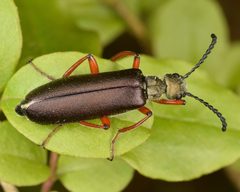
Lytta aenea is a blister beetle ( Meloidae) native to eastern North America, ranging from Texas to New England and westward to the Great Plains. The 'Brassy Blister Beetle' refers to its distinctive bronze-colored . It is a flower-feeding with documented associations to several plant families.
Pronunciation
How to pronounce Lytta aenea: /ˈlɪtə əˈnɛa/
These audio files are automatically generated. While they are not always 100% accurate, they are a good starting point.
Identification
The bronze or brassy metallic separate this from most other Lytta species, which often exhibit blue, green, or striped coloration. The combination of metallic bronze coloration with eastern North American distribution helps distinguish it from western species like L. magister (which is larger and more robust with different coloration).
Images
Appearance
have metallic bronze that give the its name. Body form is typical of blister beetles: soft-bodied with a somewhat elongated shape and a broad pronotum. The metallic coloration distinguishes it from many .
Habitat
Associated with flowering vegetation in open and semi-open . Occurs in areas supporting its plants, including woodland edges, meadows, and areas with Rosaceae shrubs and trees.
Distribution
Eastern North America from Texas north to New England, extending west to the Great Plains. Records include Vermont and other northeastern states.
Diet
feed primarily on flowers of Rosaceae. Additional documented food sources include willow (Salix), hickory (Carya), and oak (Quercus) flowers and foliage.
Host Associations
- Rosaceae - food sourceprimary
- Salix - food sourcewillow flowers
- Carya - food sourcehickory flowers
- Quercus - food sourceoak leaves
Human Relevance
Like all blister beetles, contains and can cause blistering if handled roughly. The chemical has historical medicinal uses, though this is not specifically documented as a source. May occasionally be a minor pest in gardens or orchards when feeding on Rosaceae flowers.
Similar Taxa
- Lytta magisterWestern North American with similar size and body form, but has black and orange/red coloration rather than metallic bronze.
- Lytta cyanipennisOverlapping distribution but has blue with black markings rather than uniform bronze.
- Lytta nuttalliMay overlap in range but has green or blue-green metallic coloration rather than bronze.
More Details
Etymology
The specific epithet 'aenea' refers to the bronze (Latin aeneus) color of the .