
Megetra
LeConte, 1859
Red-banded Blister Beetles
Species Guides
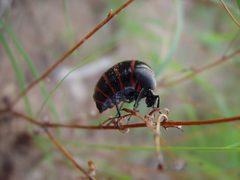
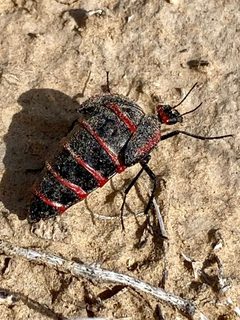
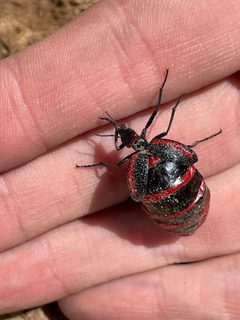
3Megetra is a North American of blister beetles (Meloidae) comprising three : M. cancellata, M. punctata, and M. vittata. These beetles are characterized by their distinctive aposematic coloration—typically red or orange markings on black —advertising their chemical defenses. The genus occurs in arid and semi-arid regions of the southwestern United States and northern Mexico, where are active during late summer and early fall, primarily on flowers of Asteraceae.
Pronunciation
How to pronounce Megetra: /mɛˈɡɛtɹə/
These audio files are automatically generated. While they are not always 100% accurate, they are a good starting point.
Identification
Megetra are distinguished from other Eupomphini by their robust body form and distinctive color patterns involving red or orange transverse bands or spots on black . M. cancellata is anatomically and ecologically the most distinctive species, with broader elytral markings and a more southerly distribution. M. vittata and M. punctata are ecologically similar and ; M. punctata was described as new in 1965 and differs from M. vittata in and larval anatomical characters. Specific identification requires examination of male genitalia and, for some comparisons, larval .
Images
Habitat
Arid and semi-arid regions including desert scrub, grasslands, and open woodlands. are found on flowering plants, particularly composites (Asteraceae), where they feed and mate.
Distribution
Southwestern United States and northern Mexico. M. cancellata: discontinuously from Arizona and New Mexico to Hidalgo, México. M. vittata: northern Arizona to western Texas. M. punctata: southern Arizona and New Mexico to Durango, México.
Seasonality
active primarily in late summer and early fall (August–September), coinciding with flowering of plants.
Diet
feed on flowers and pollen of Asteraceae and other flowering plants.
Behavior
are and frequently observed on flowers. The bright coloration of M. punctata has been noted as aposematic, warning of chemical defenses. Larval is poorly documented but likely involves typical of Meloidae, with triungulin larvae seeking .
Ecological Role
function as while feeding on flowers. Like other blister beetles, they produce , a defensive compound toxic to vertebrates, which may influence .
Human Relevance
production makes these beetles potentially toxic if ingested, though they are not commonly encountered in sufficient numbers to pose significant risk. The aposematic coloration makes them subjects of ecological and behavioral study.
Similar Taxa
- EpicautaBoth are meloid with aposematic coloration, but Epicauta are generally more elongate with different antennal and leg proportions, and occur in different ecological contexts.
- LyttaAnother meloid with warning coloration, but Lytta typically have different body proportions, more metallic coloration, and distinct larval associations.
- TegroderaShares tribe Eupomphini and similar robust build, but Tegrodera has distinctive elytral sculpturing and different color pattern elements.