
Melandryini
Leach, 1815
Genus Guides
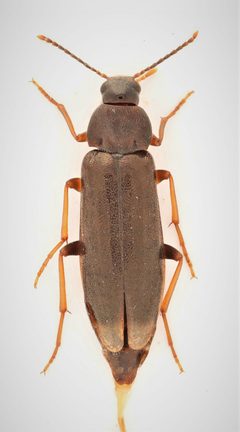
4Melandryini is a tribe of beetles within the Melandryidae, established by Leach in 1815. Members are commonly known as false darkling beetles. The tribe encompasses multiple of small to medium-sized beetles primarily associated with decaying wood and fungal . iNaturalist records 863 observations, indicating moderate documentation effort.

Pronunciation
How to pronounce Melandryini: //ˌmɛlənˈdraɪɪnaɪ//
These audio files are automatically generated. While they are not always 100% accurate, they are a good starting point.
Identification
Melandryini beetles can be distinguished from other tenebrionoid beetles by the combination of: tarsal formula 5-5-4 (five segments on fore and mid , four on hind tarsi); with weak to moderate club, not strongly ; pronotum usually narrower than at base with distinct hind angles; and body form generally elongate-oval rather than strongly cylindrical. Separation from related tribes within Melandryinae (such as Osphyini) requires examination of male genitalia and detailed tarsal structure.
Images
Habitat
Associated with dead and decaying hardwood, particularly in mature forests. Often found under bark of fallen logs, in rotting wood, and in fungal fruiting bodies. Moist woodland environments with substantial coarse woody debris are preferred.
Distribution
Holarctic distribution, with primary diversity in temperate regions of North America and Eurasia. Records extend through Europe, northern Asia, and North America.
Seasonality
activity generally peaks in spring and early summer (April–June in temperate zones), with some extending into autumn. Larval development occurs within wood substrate year-round.
Host Associations
- decaying hardwood - larval development and shelter
- wood-decay fungi - associated with fungal fruiting bodies
Life Cycle
Complete with , larva, pupa, and stages. Larvae are elongate, moderately sclerotized, and develop within decaying wood. Development likely spans one to two years depending on climate and wood decay state. occurs in wood substrate.
Behavior
are or , often found on fungal fruiting bodies at night. When disturbed, adults may feign death (). Both adults and larvae are slow-moving and remain concealed in wood cavities during daylight.
Ecological Role
Contributes to wood decomposition through larval feeding activities in decaying wood. Serves as prey for woodland including birds and small mammals. Associated with fungal in forest .
Human Relevance
No significant economic importance. Occasionally encountered by entomologists and naturalists in woodland surveys. Not known to be a pest of timber or stored products.
Similar Taxa
- OsphyiniAnother tribe in Melandryinae; distinguished by different male genitalia structure and generally more robust body form
- Tenebrionidae of darkling beetles; Melandryini have 5-5-4 tarsal formula versus 5-5-4 or variable in Tenebrionidae, and lack the strongly rounded pronotum typical of many tenebrionids
- Mycetophagidae of hairy fungus beetles; Melandryini lack the dense setae and more compact body form of mycetophagids
More Details
Taxonomic Note
Melandryini as currently constituted may not be monophyletic; molecular phylogenetic studies of Melandryidae are limited and tribal boundaries remain under investigation.