
Symphora flavicollis
(Haldeman, 1848)
Red-necked False Darkling Beetle
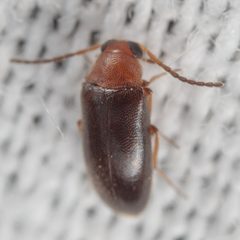
Symphora flavicollis, commonly known as the Red-necked , is a of false darkling beetle in the Melandryidae. The species was described by Haldeman in 1848 and is distinguished by its characteristic yellowish or reddish pronotum that contrasts with the darker body. It belongs to a small of beetles that are often associated with decaying wood and fungal .
Pronunciation
How to pronounce Symphora flavicollis: /sɪmˈfɔː.rə ˌflæv.ɪˈkɒl.ɪs/
These audio files are automatically generated. While they are not always 100% accurate, they are a good starting point.
Identification
The combination of a brightly colored yellowish-red pronotum contrasting with dark is diagnostic for this within its . Similar darkling beetles in related (Tenebrionidae, Scraptiidae) may share general body form but differ in pronotal coloration and antennal structure. The family Melandryidae can be distinguished from true darkling beetles (Tenebrionidae) by the structure of the pretarsal claws and the more elongate, less robust body form.
Images
Appearance
have a distinct yellowish to reddish-orange pronotum (the segment behind the ) that contrasts sharply with the darker brown to black and , giving rise to the "flavicollis" (yellow-necked). The body is elongate and somewhat flattened, typical of false darkling beetles. are thread-like and moderately long. The overall size is small to medium for the .
Habitat
Associated with decaying wood, dead logs, and fungal fruiting bodies in forested and wooded areas. The Melandryidae is generally linked to moist, decaying woody substrates where larvae feed on fungi.
Distribution
Eastern North America. Documented from Canadian provinces: Manitoba, New Brunswick, Nova Scotia, Ontario, and Prince Edward Island. The likely occurs more broadly in the northeastern and north-central United States, though specific records are sparse in the provided sources.
Diet
Larvae feed on fungi associated with decaying wood. feeding habits are presumed to include fungal material and possibly pollen, but specific dietary details are not well documented.
Life Cycle
Complete with , larva, pupa, and stages. Larvae develop in decaying wood and are mycetophagous (fungus-feeding). Detailed information is not available in the provided sources.
Behavior
are likely or , seeking shelter under bark or in decaying wood during the day. Attracted to light on occasion. Specific behavioral observations are limited.
Ecological Role
Decomposer; contributes to nutrient cycling in forest through larval feeding on fungi in decaying wood. Part of the of insects that facilitate wood decomposition.
Human Relevance
No significant economic importance. Occasionally encountered by entomologists and naturalists in forest . Not a pest of stored products or structures.
Similar Taxa
- Symphora undulataCongeneric with similar body form but differing in pronotal coloration and pattern; S. flavicollis has more uniformly colored pronotum
- Scraptia spp.Related Scraptiidae with similar elongate form, but distinguished by antennal club structure and different tarsal formula
- Melandrya spp.Larger congeneric or related false darkling beetles with different color patterns and typically more robust build
More Details
Taxonomic History
Originally described by Haldeman in 1848, this has remained in the Symphora with no major taxonomic revisions noted in available sources. The Melandryidae has undergone some reclassification, formerly included within Tenebrionidae as a .
Collection Records
Specimens are present in major North American entomological collections, including the Canadian National Collection, based on distribution records from Manitoba, New Brunswick, Nova Scotia, Ontario, and Prince Edward Island.