
Amblyderus pallens
(LeConte, 1850)
pale ant-like flower beetle
Amblyderus pallens is a small, flightless -like flower beetle in the Anthicidae. It is restricted to dune and sandy beach across central and eastern North America, with a notable absence from western regions. The is considered critically imperiled in Saskatchewan and Manitoba, Canada. are active primarily during warmer months but have been observed in winter in some areas.
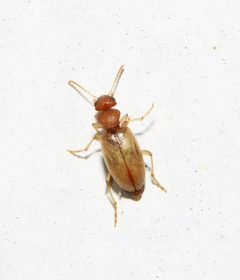
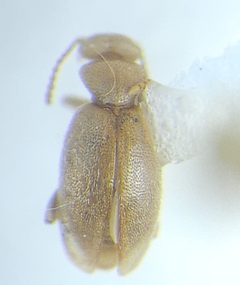
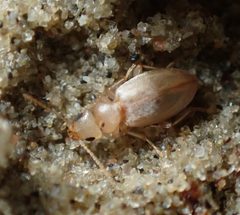
Pronunciation
How to pronounce Amblyderus pallens: /ˈæmblɪˌdɛrəs ˈpælənz/
These audio files are automatically generated. While they are not always 100% accurate, they are a good starting point.
Identification
Distinguished from other Anthicidae by combination of small size (3.1–4.2 mm), pale yellow to brown coloration, lightly reticulated dorsum with sometimes smooth , and dense appressed setae on . Flightlessness due to reduced wings separates it from fully winged . specificity to dunes and sandy beaches provides additional diagnostic context.
Images
Appearance
Body length 3.1–4.2 mm. Coloration variable, ranging from yellow to light yellow and brown. Dorsum lightly reticulated, though sometimes smooth. Body setae appressed and dense on . wings reduced, rendering the flightless. Overall -like in general form, typical of the Anthicidae.
Habitat
Strictly associated with dune and sandy beach . occur in sand beneath plants and debris such as beach drift, and among grass roots at depths of 4–8 cm below the surface. Coastal and inland dune systems both occupied.
Distribution
North America: central and eastern United States and southern Canada. Absent from western North America. Canadian records from Alberta, Saskatchewan, Manitoba, Ontario, Quebec, New Brunswick, Nova Scotia, and Prince Edward Island. United States records from Arizona, Colorado, Florida, Georgia, Illinois, Indiana, Louisiana, Maine, Massachusetts, Michigan, Mississippi, Missouri, Nebraska, New Hampshire, New Jersey, New Mexico, New York, North Carolina, Oklahoma, South Carolina, South Dakota, Texas, Virginia, and Wisconsin.
Seasonality
active primarily May through August. Activity also recorded November through February in some regions, indicating potential winter activity or extended seasonal presence in milder climates.
Behavior
hide under plants and debris in sandy substrates, and burrow among grass roots. Flightlessness restricts to .
Human Relevance
NatureServe conservation status: critically imperiled (S1) in Saskatchewan and Manitoba, Canada. No other documented economic or cultural significance.
Similar Taxa
- Other Amblyderus speciesSimilar -like form and size; distinguished by wing condition (A. pallens flightless), coloration, and specific dune association
- Other Anthicidae generaGeneral -like appearance shared across ; A. pallens identified by combination of size, pale color, reticulation pattern, and reduced wings
More Details
Conservation status
Critically imperiled (S1) in Saskatchewan and Manitoba per NatureServe assessment, reflecting restricted distribution and specificity in these provinces.