
Coproporus
Kraatz, 1857
Species Guides
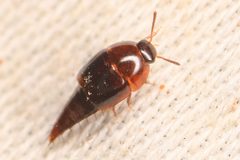
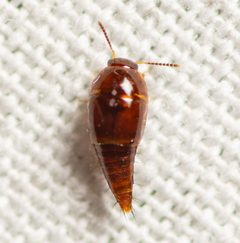
4Coproporus is a of rove beetles in the Staphylinidae, Tachyporinae, tribe Vatesini. The genus has a distribution with records from North America, Europe, and South America. Taxonomic revision has clarified confused generic usage and resolved synonymies, particularly distinguishing Coproporus from the related genus Cilea. Nine occur in North America north of Mexico, with additional species documented from Mexico, Panama, Argentina, and Brazil.
Pronunciation
How to pronounce Coproporus: //kɒprəˈpɔːrəs//
These audio files are automatically generated. While they are not always 100% accurate, they are a good starting point.
Identification
Diagnostic characters include features of the male genitalia and external visible under scanning electron microscopy. The can be distinguished from the related genus Cilea by structural characters detailed in taxonomic revisions. A diagnostic key to North American is available in the revision by Campbell (1975).
Images
Distribution
distribution. Documented from North America (USA, Canada, Mexico), Europe (Denmark, Norway, Sweden), and South America (Argentina, Brazil, Panama). Specific North American records include Vermont and other US states. One , C. segnis, has been reported from the United States for the first time based on revision work.
Similar Taxa
- CileaHistorically confused with Coproporus; distinguished by structural characters and male genitalia . Cilea silphoides is the only North American of that .
- ErchomusJunior synonym of Coproporus; priority of Coproporus Kraatz, 1857 over Erchomus Motschulsky has been established.
More Details
Taxonomic History
The usage of Coproporus and Cilea has been confused in previous publications. Campbell (1975) clarified the synonymy and priority of Coproporus vs. Erchomus Motschulsky. Several Latin American formerly treated as synonyms were recognized as valid species based on examination of type material, including C. convexus, C. ignavus, and C. terminatus.
Species Count
Nine are documented from North America north of Mexico. The contains additional species in Central and South America, including C. rutilus piceorufus and C. rutilus obscurior, which were elevated from aberration to species status.