
Quedius molochinus
(Gravenhorst, 1806)
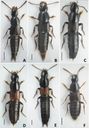
Quedius molochinus is a large, robust rove beetle in the subgenus Quedius sensu stricto. It is one of the most widespread in its across the Palearctic region. The species has been introduced to eastern Canada, likely through historical ship ballast transport. Recent molecular studies have revealed unexpected cryptic diversity within this morphologically uniform species.
Pronunciation
How to pronounce Quedius molochinus: //ˈkwɛdiəs moʊˈlɒkɪnəs//
These audio files are automatically generated. While they are not always 100% accurate, they are a good starting point.
Identification
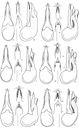
Belongs to the Q. molochinus-group, characterized by large body size and robust build within the . Distinguished from Q. pallipes and Q. fuliginosus by aedeagal . Recent COI barcode studies suggest potential cryptic -level diversity that is not currently reflected in external morphology or structure.
Images
Distribution
Native to the Palearctic: Europe (Austria, Belgium, Czech Republic, Germany, Estonia, Faroe Islands, Finland, France, Great Britain, Georgia, Greece, Hungary, Italy, Latvia, Lithuania, Luxembourg, Moldova, Norway, Poland, Slovakia, Sweden, Switzerland, Ukraine), Russia (European part, western Siberia), Cyprus, Morocco, Algeria, and Tunisia. Introduced to eastern Canada (Newfoundland, Nova Scotia, Prince Edward Island, Quebec).
Behavior
Human-mediated has been documented, with establishment in eastern Canada attributed to historical transport in ship ballast.
Human Relevance
Accidental introduction to North America through maritime shipping; established in eastern Canada.
Similar Taxa
- Quedius pallipesFormerly confused due to synonymy of Q. sardous and Q. leonhardi; now distinguished by aedeagal and COI barcode patterns
- Quedius fuliginosusAnother large, robust Quedius s. str. with similar Palearctic distribution and human-mediated introduction to Nearctic
More Details
Cryptic diversity
COI barcode analysis of 22 specimens revealed three non-sister clades with 6.3–7.8% molecular divergence, suggesting unrecognized -level diversity. Preliminary examination of the aedeagal internal sac did not reveal corresponding morphological differences, contrary to patterns seen in some other groups where endophallic characters support molecular cryptic species.
Taxonomic history
Quedius sardous Gridelli, 1924 and Q. leonhardi Bernhauer, 1914 were moved from synonymy with Q. molochinus to synonymy with Q. pallipes in the 2022 revision of Quedius s. str.