
Quedius
Stephens, 1829
Species Guides
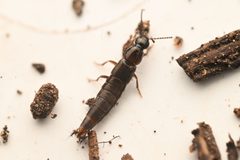
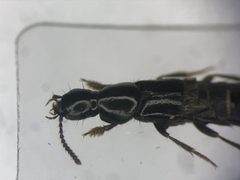
49Quedius is a large of rove beetles (Staphylinidae) containing approximately 800 described . Species vary considerably in size, with members of the subgenus Quedius sensu stricto being among the largest and most robust in the genus. The genus has a primarily Holarctic distribution, though species occur across much of the Northern Hemisphere including Middle Asia, China, and the Caucasus. Many species are associated with montane , and some exhibit hypogean (subterranean) adaptations including winglessness.
Pronunciation
How to pronounce Quedius: //ˈkwɛdi.əs//
These audio files are automatically generated. While they are not always 100% accurate, they are a good starting point.
Images
Habitat
Many are associated with montane environments, including high-elevation talus slopes and rocky . Some species are hypogean (subterranean), occurring in montane talus and cave-like microhabitats. The subgenus Quedius sensu stricto is restricted to the Holarctic region.
Distribution
Primarily Holarctic, with documented across North America, Europe, and northern Asia. Middle Asian fauna includes Kazakhstan, Kyrgyzstan, Tajikistan, Turkmenistan, and Uzbekistan. Chinese species occur in Yunnan, Beijing, and Sichuan. Some species have been introduced from the Palearctic to the Nearctic through human-mediated , including Q. fuliginosus, Q. curtipennis, and Q. molochinus.
Behavior
Some are winter-active; Q. pellax has been documented as a winter-active . Human-mediated through historical transport of ship ballast has been noted as a regular phenomenon for some members of the subgenus Quedius sensu stricto.
Human Relevance
Some have been introduced to new regions through human activity, particularly via ship ballast transport. The serves as a subject of ongoing taxonomic research due to its and complex biogeographic patterns.
Similar Taxa
- HeterothopsBoth were historically used as taxonomic 'wastebaskets' for similar-looking rove beetles; recent revisions have established new to reduce this problem
- Other Staphylininae generaQuedius , especially in subgenus Quedius sensu stricto, are distinguished by their large size and robust body form relative to many other rove beetle
Sources and further reading
- BugGuide
- Wikipedia
- GBIF taxonomy match
- iNaturalist taxon
- NCBI Taxonomy
- Catalogue of Life
- Revision of Quedius sensu stricto (Coleoptera: Staphylinidae)
- New and little known species of Quedius from West Palaearctic (Coleoptera: Staphylinidae: Staphylininae)
- Distributional Pattern and Development of the Winter-Active Beetle Quedius pellax (Staphylinidae)
- Rove beetles of the genus Quedius (Coleoptera, Staphylinidae) of Russia: a key to species and annotated catalogue
- New species and records of Quedius rove beetles (Coleoptera, Staphylinidae, Staphylininae) from Middle Asia
- Three new species of Quedius elpenor group (Coleoptera: Staphylinidae: Staphylinini: Quediina) from China
- Hypogean presumably sister species Quedius repentinus sp. n. from Altai and Q. roma from Sikhote-Alin (Coleoptera: Staphylinidae): a disjunct distribution or poorly sampled Siberia?
- Revision of the Quedius fauna of Middle Asia (Coleoptera, Staphylinidae, Staphylininae)
- Taxonomy of the poorly known Quedius mutilatus group of wingless montane species from Middle Asia (Coleoptera: Staphylinidae: Staphylinini)
- Two new rove beetle genera in Staphylininae that reduce "Heterothops" and "Quedius" taxonomic wastebaskets (Coleoptera, Staphylinidae).