
Quedius cruentus
(Olivier, 1795)
orange-tipped rove beetle
Quedius cruentus is a rove beetle in the Staphylinidae, commonly known as the orange-tipped rove beetle. It is a medium-sized with distinctive coloration that has been introduced to North America from its native Palearctic range. The species is frequently recorded and has established in northeastern North America.
Pronunciation
How to pronounce Quedius cruentus: /ˈkwe.di.us kruˈen.tus/
These audio files are automatically generated. While they are not always 100% accurate, they are a good starting point.
Identification
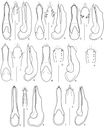
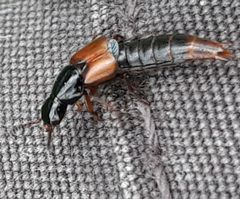
Distinguished from other Quedius by the combination of black body with orange-red markings at the tips of the . Similar species in the may lack these colored markings or have different color patterns. The overall body proportions and punctation of the elytra and pronotum are important for definitive identification and may require examination of genitalia.
Images
Habitat
Found in varied terrestrial including forest litter, decaying organic matter, and environments. Has been recorded in urban and suburban settings in its introduced North American range, suggesting adaptability to human-modified habitats.
Distribution
Native to Europe, North Africa (Morocco, Algeria, Tunisia), Turkey, Armenia, and Russia (European part). Introduced and established in North America: Canada (Ontario, Quebec) and USA (Massachusetts, Maine, Michigan, New Jersey, New York, Ohio, Pennsylvania). Records from India and Iran require verification.
Seasonality
have been recorded across multiple months; activity patterns likely vary by region. In temperate North America, active during warmer months.
Ecological Role
As a member of Staphylinidae, likely functions as a or scavenger in soil and litter , though specific ecological studies are lacking.
Human Relevance
Introduced in North America; no documented economic or medical significance. Presence in suggests it may be encountered frequently in urban areas.
Similar Taxa
- Quedius species lacking elytral color markingsMany are uniformly black or have different color patterns; Q. cruentus is distinguished by orange-red elytral apices
- Other Staphylininae with colored elytral markingsRequires examination of body proportions, punctation, and genitalia to distinguish from unrelated rove beetles with convergent coloration
More Details
Taxonomic note
The was described by A.G. Olivier in 1795. It belongs to the large Quedius, which contains numerous species with subtle morphological differences requiring careful identification.
Invasion biology
The has been present in North America since at least the early 20th century and is considered established. Its spread may be facilitated by human transport of organic materials.