
Philonthus thoracicus
(Gravenhorst, 1802)
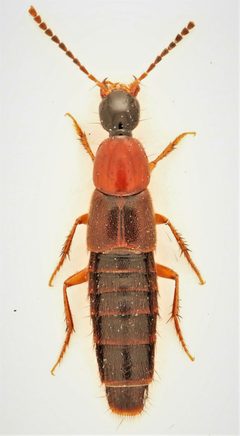
Philonthus thoracicus is a of rove beetle in the Staphylinidae. As a member of the Philonthus, it is part of a large group of predatory beetles commonly associated with decomposing organic matter. The species occurs across much of North America, with documented records from Canada and numerous U.S. states. Like other Philonthus species, it likely inhabits carrion, , and other nutrient-rich decaying substrates where it preys on small .
Pronunciation
How to pronounce Philonthus thoracicus: /fɪˈlɒnθəs θɔːˈræsɪkəs/
These audio files are automatically generated. While they are not always 100% accurate, they are a good starting point.
Identification
Members of Philonthus can be recognized by the typical staphylinid body plan: shortened exposing most of the , slender elongated body, and relatively large . Philonthus thoracicus specifically would require examination of thoracic characters—likely the pronotal shape or markings implied by the epithet "thoracicus"—to distinguish from . Accurate identification to species level in this typically requires microscopic examination of genitalia and other subtle morphological features.
Images
Habitat
Decaying organic matter including carrion, , compost, and other decomposing substrates. The has been documented in association with carcasses and is likely found in similar to other Philonthus species that frequent carrion and decomposition sites.
Distribution
Canada (Alberta, Manitoba, New Brunswick, Ontario, Quebec, Saskatchewan) and USA (Arkansas, Colorado, District of Columbia, Iowa, Illinois, Indiana, Kansas, Kentucky, Massachusetts, Maryland, Maine, Minnesota, Missouri, North Carolina, North Dakota, Nebraska, New Hampshire, New Jersey, New York, Ohio, Oklahoma, Pennsylvania, South Dakota, Texas, Utah, Virginia, Wisconsin).
Ecological Role
As a predatory rove beetle, likely contributes to decomposition processes by preying on fly larvae and other small associated with carrion and decaying matter. This predatory activity helps regulate of other carrion inhabitants and may indirectly influence decomposition rates.
Human Relevance
Has potential relevance to due to its association with carrion. The presence of Philonthus on carcasses can provide information about postmortem interval and environmental conditions, though specific forensic applications for P. thoracicus have not been documented.
Similar Taxa
- Philonthus politusAnother small rove beetle (~10 mm) found in similar carrion ; distinguished by specific thoracic and abdominal markings and genitalia structure
- Philonthus caeruleipennisLarger (12-15 mm) with distinctive metallic blue-green ; differs in coloration and size from P. thoracicus
- Creophilus maxillosusMuch larger (11-23 mm), densely hairy rove beetle with similar carrion ; easily distinguished by size and conspicuous setation
Sources and further reading
- BugGuide
- GBIF taxonomy match
- iNaturalist taxon
- NCBI Taxonomy
- Catalogue of Life
- A Buggy New Year! | Bug Squad
- Retrachydes thoracicus – times four! | Beetles In The Bush
- Boisterous bee-havior of ground nesting bees, Colletes thoracicus — Bug of the Week
- Bug Eric: Fungus Party-y-y!
- Bug Eric: More Beetles from Bones
- Spring sunshine heralds the appearance of plasterer bees: Colletes — Bug of the Week