
Philonthus asper
Horn, 1884
Philonthus asper is a of rove beetle in the Staphylinidae, described by Horn in 1884. It belongs to the large Philonthus, which comprises numerous predatory species commonly found in decaying organic matter, carrion, and fungal . The species is documented from eastern North America, with records spanning Canada and the eastern United States. Like other members of its genus, it is presumed to be a of small in microhabitats rich in decomposing material.
Pronunciation
How to pronounce Philonthus asper: /pʰɪˈlɒnθəs ˈæspər/
These audio files are automatically generated. While they are not always 100% accurate, they are a good starting point.
Identification
Philonthus asper can be distinguished from other Philonthus primarily by subtle morphological characters, likely involving the degree and pattern of surface sculpturing given its specific epithet. Accurate identification typically requires examination of male genitalia and detailed comparison with . The species is not readily separable from in the field without microscopic examination. It may be confused with P. politus and other common Philonthus species in carrion and fungal , from which it differs in details of punctation, setation, and aedeagal structure.
Images
Appearance
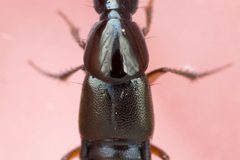
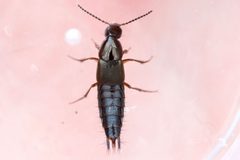
As a member of Philonthus, this exhibits the characteristic rove beetle : elongated body with notably short that leave most of the exposed, and relatively long, slender legs. The specific epithet "asper" (Latin for "rough") suggests the species may possess roughened surface sculpturing on the , possibly on the elytra or pronotum, distinguishing it from smoother . Detailed diagnostic features for field identification are not well documented in available sources.
Habitat
Decaying organic matter including carrion, fungi, and compost; likely associated with moist microhabitats in forested and open environments where decomposition processes are active.
Distribution
Eastern North America: Canada (Ontario, Quebec) and eastern United States (District of Columbia, Georgia, Illinois, Indiana, Maryland, North Carolina, New Jersey, New York, Ohio, Pennsylvania, South Carolina, Tennessee, Virginia, West Virginia).
Ecological Role
As a member of the predatory rove beetle Philonthus, this likely functions as a of small (fly and larvae, , mites, and other microarthropods) in decomposing organic substrates. It contributes to nutrient cycling and carrion/fungal dynamics through and potentially through competitive interactions with other carrion- and fungus-associated beetles.
Human Relevance
Minimal direct human relevance. Like other Philonthus , it may occasionally be encountered by forensic entomologists in carrion studies, though it is not among the most commonly cited species in forensic contexts. Not known to be a pest or beneficial species in agriculture or stored products.
Similar Taxa
- Philonthus politusCommon carrion-associated with which it shares ; distinguished by surface sculpturing and male genitalia
- Philonthus caeruleipennisLarger, metallic blue-green found in similar fungal ; distinguished by coloration and larger size (12-15 mm)
- Creophilus maxillosusMuch larger hairy rove beetle in same ; distinguished by conspicuous setae and larger size (11-23 mm)
More Details
Taxonomic note
The specific epithet "asper" (rough) is shared with several other organisms and reflects a morphological characteristic of the ' surface texture. The species was described by George Henry Horn, a prominent 19th-century American coleopterist, in 1884.
Observation scarcity
With only 11 observations recorded on iNaturalist as of source date, this appears to be infrequently encountered or underreported, possibly due to identification challenges requiring expert examination.