
Gabrius brevipennis
(Horn, 1884)
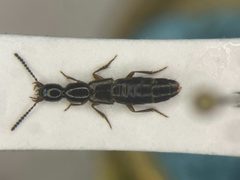
Gabrius brevipennis is a rove beetle in the Staphylinidae, described by Horn in 1884. Originally placed in the Philonthus, it was later transferred to Gabrius. The is broadly distributed across northern North America, occurring in Canada from British Columbia to Newfoundland and in the northern United States from Washington to New England. Like other members of the tribe Philonthina, it is likely a predatory associated with decaying organic matter and soil . The specific epithet "brevipennis" refers to its relatively short , a characteristic feature of many rove beetles.
Pronunciation
How to pronounce Gabrius brevipennis: /ˈɡæb.ri.əs ˌbrɛ.vɪˈpɛn.ɪs/
These audio files are automatically generated. While they are not always 100% accurate, they are a good starting point.
Identification
Distinguished from other Gabrius by the combination of its size, body proportions, and the shortened indicated by its specific epithet. The Gabrius can be separated from the closely related Philonthus by subtle differences in the male genitalia and the structure of the . Accurate identification to species level typically requires examination of these characters under magnification. The short elytra leave most of the exposed, typical of Staphylinidae.
Images
Habitat
Found in diverse terrestrial across its broad northern range, including forest floors, riparian zones, and areas with decaying plant matter. Like many rove beetles, it is likely associated with moist microhabitats under stones, logs, and leaf litter where prey and shelter are abundant.
Distribution
Canada: Alberta, British Columbia, Manitoba, New Brunswick, Newfoundland, Nova Scotia, Northwest Territories, Ontario, Prince Edward Island, Quebec, Saskatchewan. United States: Alaska, Massachusetts, Maine, Michigan, New Hampshire, New York, Vermont, Washington, Wisconsin.
Similar Taxa
- Philonthus spp.Formerly classified in this ; shares similar body form and preferences but differs in genitalic structure
- Other Gabrius speciesRequire careful examination of aedeagal structure and other subtle morphological characters for separation
Sources and further reading
- BugGuide
- GBIF taxonomy match
- iNaturalist taxon
- NCBI Taxonomy
- Catalogue of Life
- Bembicid Holdings | Entomology Research Museum
- Minstrels of the meadow: Short-winged meadow katydid, Conocephalus brevipennis — Bug of the Week
- Disteniidae | Beetles In The Bush
- Archive — Bug of the Week
- insects | Beetles In The Bush | Page 10