
Euconnus rasus
(J.L. LeConte, 1852)
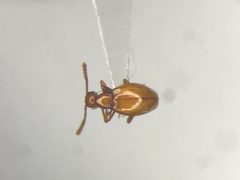
Euconnus rasus is a minute rove beetle in the Scydmaeninae, first described by John Lawrence LeConte in 1852. Members of this are among the smallest beetles, typically measuring under 2 mm. The has been recorded across northeastern North America, with scattered observations in the Great Lakes region and Atlantic coastal states. Like other scydmaenines, it likely inhabits leaf litter and other decaying organic matter, though specific ecological details remain poorly documented.
Pronunciation
How to pronounce Euconnus rasus: /juːˈkɒnəs ˈreɪsəs/
These audio files are automatically generated. While they are not always 100% accurate, they are a good starting point.
Identification
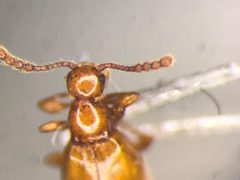
Euconnus rasus belongs to a characterized by extremely small body size (usually 1–2 mm), compact oval body form, and with a weakly defined club. -level identification in Euconnus requires examination of microscopic features including male genitalia and detailed antennal structure. E. rasus may be distinguished from congeneric species by subtle differences in pronotal and elytral proportions, though definitive identification typically requires reference to LeConte's original description or subsequent taxonomic revisions.
Images
Distribution
Recorded from Canada (Ontario, Quebec) and the United States (Connecticut, District of Columbia, Iowa, Illinois, Indiana, Massachusetts, Michigan, New Hampshire, New York, Pennsylvania).
Similar Taxa
- Other Euconnus speciesCongeneric share minute size and compact body form; differentiation requires microscopic examination of genitalia and antennal details.
- Other Scydmaeninae genera (e.g., Scydmaenus, Cephennium)Similar microhabitat preferences and body size; Euconnus typically have more compact body proportions and less pronounced antennal club.
More Details
Taxonomic history
Described by J.L. LeConte in 1852, this has received limited modern taxonomic study. The Euconnus is speciose and taxonomically challenging, with many species distinguished only by subtle morphological characters.
Data limitations
Only four verified observations exist in iNaturalist as of source date, reflecting the difficulty of detecting and identifying these minute beetles. Most occurrence records derive from museum specimens rather than systematic surveys.