
Thesium
L.
Rootthugs
Species Guides
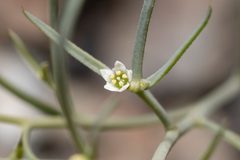
1Thesium is a of hemiparasitic flowering plants in the Santalaceae, with approximately 325 distributed primarily across Africa, Europe, and Asia. The genus is particularly diverse in South Africa, where roughly half of all species occur. Species in this genus are root hemiparasites that form haustorial connections to plant roots. The genus has undergone taxonomic revision, with several segregate genera (Austroamericium, Chrysothesium, Kunkeliella, Thesidium) now subsumed within Thesium.
Pronunciation
How to pronounce Thesium: /ˈθiːziəm/
These audio files are automatically generated. While they are not always 100% accurate, they are a good starting point.
Images
Habitat
Thesium occupy grassland and open vegetation , including forest-steppe and meadow . Specific habitat requirements vary by species; some occur in peri-Carpathian forest-steppe vegetation, while others inhabit alpine or subalpine zones in the Himalayas. In Lithuania, T. ramosum was found in association with Fabaceae species, with negative correlation to Poaceae coverage.
Distribution
The has a wide distribution across the Old World, with centers of diversity in South Africa (approximately 50% of ), the Mediterranean region, and temperate Eurasia extending to western China. Specific species distributions include: T. ebracteatum in central and eastern Europe (including a relict in Romania); T. ramosum native to western Europe through western China, with introduced populations in North America (Alberta, three western US states) and Lithuania; T. jarmilae in the Sikkim Himalaya; and Canarian endemics in T. sect. Kunkeliella (including T. palmense on La Palma).
Ecological Role
As root hemiparasites, Thesium form haustorial connections to plant roots, extracting water and nutrients while maintaining photosynthetic capacity. The relationship with host plants shows selectivity patterns that vary among species. In some , Thesium species serve as indicators of undisturbed grassland and relict vegetation.
Human Relevance
Several Thesium have conservation significance: T. ebracteatum is listed in Annex II of the EU Directive and appears on national Red Lists across Europe; T. palmense and other Canarian endemics in T. sect. Kunkeliella are subject to in situ and ex situ conservation efforts; T. ramosum is regulated by the USDA in the United States due to potential and has established in Alberta, Canada. T. chinense is used in traditional Chinese medicine.
Similar Taxa
- ComandraShares Santalaceae (or Comandraceae) and hemiparasitic habit; differs in determinate growth and unbranched stems versus indeterminate, branched aerial stems in Thesium
- GeocaulonRelated native in North America with similar hemiparasitic habit; distinguished by determinate growth and unbranched habit compared to Thesium ramosum
More Details
Taxonomic History
The has been subject to significant taxonomic revision. Nickrent and colleagues have argued that Austroamericium, Chrysothesium, Kunkeliella, and Thesidium should be treated as synonyms of Thesium. Thesiaceae is sometimes recognized as a separate , though most sources place Thesium in Santalaceae.
Conservation Status
One in T. sect. Kunkeliella is already considered extinct. The section represents Canarian endemics with restricted distributions and high threat levels.
Sources and further reading
- BugGuide
- Wikipedia
- iNaturalist taxon
- NCBI Taxonomy
- Catalogue of Life
- Notes on the enigmatic Thesium linophyllon and report on Thesium ramosum in Lithuania
- Relaciones genéticas y morfológicas del género Thesium en Canarias. Thesium palmense, una nueva especie a conservar Genetic and morphological relationships of Thesium in the Canary Islands. Thesium palmense, a new species to conserve
- Habitat requirements and host selectivity of Thesium species (Santalaceae)
- The genus Thesium L. (Santalaceae) in India: Addition of Thesium jarmilae Hendrych to the flora of India
- Notes on the nomenclature, characteristics, status, and biology of Field Thesium, Thésium des Champs (<i>Thesium ramosum</i> Hayne; Thesiaceae/Santalaceae), a potentially serious invasive plant in Alberta
- Species diversity and host of Thesium chinense community
- Thesium ebracteatum (Santalaceae) rediscovered in Romania: ecological and biogeographical context
- Complex evaluation for influence of hosts on hemipatasite Thesium chinense