
Paederus mexicanus
Erichson, 1840
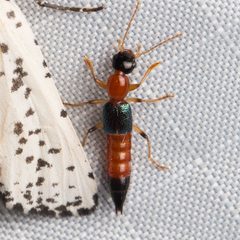
Paederus mexicanus is a rove beetle in the Staphylinidae, first described by Erichson in 1840. The Paederus is notable for containing that produce , a potent vesicant compound in their that causes dermatitis and blistering on human skin upon contact. As a member of the Paederus genus, this species likely shares this defensive chemical trait, though species-specific documentation is limited. The species occurs in the southwestern United States and Mexico.
Pronunciation
How to pronounce Paederus mexicanus: /ˈpædərəs ˌmɛksɪˈkeɪnəs/
These audio files are automatically generated. While they are not always 100% accurate, they are a good starting point.
Images
Distribution
Documented from Arizona, USA and Mexico. Distribution records are sparse, with only 22 observations recorded on iNaturalist as of source date.
Human Relevance
Members of the Paederus, including potentially P. mexicanus, are known for causing Paederus dermatitis (also called whiplash dermatitis) when crushed against human skin. The contains , a toxic amide that causes severe blistering, burning, and linear . This medical significance has been documented for related such as P. fuscipes, which was historically used as a biological weapon. Direct evidence for P. mexicanus specifically is not documented in provided sources.
More Details
Toxicity note
While the Paederus is well-known for production, -level confirmation of for P. mexicanus is not explicitly documented in available sources. The toxic properties are inferred from genus-level characteristics.
Sources and further reading
- BugGuide
- GBIF taxonomy match
- iNaturalist taxon
- Catalogue of Life
- Field Guide Selected References
- Grasshoppers of Colorado
- Grasshoppers of Colorado
- Bembicid Holdings | Entomology Research Museum
- UC Davis Doctoral Students in Entomology Got It Right | Bug Squad
- The Sting of Defeat: A Brief History of Insects in Warfare