
Paederus littorarius
Gravenhorst, 1806
Shore Rove Beetle
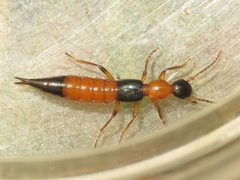
Paederus littorarius is a of rove beetle in the Staphylinidae, commonly known as the Shore Rove Beetle. Like other members of the Paederus, this species produces , a toxic compound in its that can cause dermatitis and blistering on human skin upon contact. The species is widely distributed across northern North America.
Pronunciation
How to pronounce Paederus littorarius: /ˈpiːdəˌrʊs lɪˌtɔːˈreɪriəs/
These audio files are automatically generated. While they are not always 100% accurate, they are a good starting point.
Identification
Paederus littorarius can be distinguished from similar rove beetles by its coastal preference, as indicated by its specific epithet "littorarius" (relating to shorelines). Members of the Paederus are generally recognized by their slender, elongated bodies with short that leave most of the exposed, and their distinctive coloration patterns. Accurate -level identification requires examination of genitalic characters and other microscopic features.
Images
Habitat
Found in shoreline and coastal environments, as suggested by its and specific epithet. The occupies areas near water bodies including lakeshores, riverbanks, and coastal regions.
Distribution
Widely distributed across northern North America. Recorded from Canada (Alberta, British Columbia, Manitoba, New Brunswick, Newfoundland and Labrador, Nova Scotia, Northwest Territories, Ontario, Quebec, Saskatchewan) and the United States (Alaska, Arizona, Colorado, Connecticut, District of Columbia, Idaho, Indiana, Massachusetts, Maryland, Maine, New Hampshire, New Mexico, Nevada, New York, Ohio, Oregon, Pennsylvania, Rhode Island, South Carolina, Utah, Washington, Wyoming).
Human Relevance
Like other Paederus , P. littorarius contains in its , a potent vesicant compound. Contact with crushed beetles or their hemolymph can cause Paederus dermatitis (also known as whiplash dermatitis or Nairobi fly dermatitis), characterized by skin irritation, blistering, and linear . This represents a minor public health concern for individuals handling beetles or in areas where beetles are attracted to lights.
Similar Taxa
- Paederus fuscipesA closely related in the same that also produces and causes similar dermatitis ; distinguished by distribution and subtle morphological differences
- Paederus sabaeusAnother -producing , commonly known as the Nairobi fly, found in Africa and similarly attracted to lights where human contact occurs
More Details
Toxicity
The Paederus is notable for containing over 600 , many of which produce , a polyketide amide synthesized by bacterial endosymbionts (Pseudomonas species). Pederin is one of the most potent animal products known, causing severe dermatitis at nanogram concentrations.
Sources and further reading
- BugGuide
- GBIF taxonomy match
- iNaturalist taxon
- NCBI Taxonomy
- Catalogue of Life
- UC Davis Doctoral Students in Entomology Got It Right | Bug Squad
- Paederus fuscipes rove beetle and Skeeter drone model - Entomology Today
- The Sting of Defeat: A Brief History of Insects in Warfare
- Building a Better Grasshopper Trap: New Design Offers Safer, More Efficient Harvest
- Quiz Yourself: 2020 Entomology Games Questions