
Rugilus rufipes
Germar, 1836
red-legged rove beetle
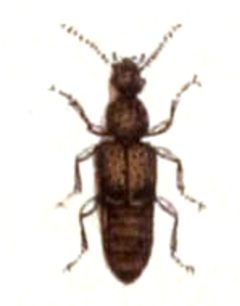
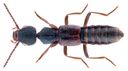
Rugilus rufipes is a small rove beetle (Staphylinidae) measuring 5–7 mm, distinguished by its dark brown to black body with contrasting red legs and . The is native to Europe and western Asia, with introduced in eastern North America. It inhabits moist terrestrial environments with abundant organic matter and is predatory on small .
Pronunciation
How to pronounce Rugilus rufipes: /ˈruːɡɪləs ˈruːfɪˌpɛs/
These audio files are automatically generated. While they are not always 100% accurate, they are a good starting point.
Identification
Distinguished from other small rove beetles by the combination of dark body with distinctly red () legs and . The short exposing most of the is characteristic of the Staphylinidae. May be confused with other Rugilus , but the specific epithet rufipes refers to the diagnostic red leg coloration.
Images
Habitat
Forest leaf litter, under stones, decaying wood, and other moist microhabitats with abundant organic matter. Particularly common in humid terrestrial environments.
Distribution
Native to Europe (widespread across central, northern, and southern Europe), Russia (European part and western Siberia), Azerbaijan, Georgia, Turkey, Iran, and Syria. Introduced to North America: Canada (New Brunswick, Ontario, Quebec) and USA (Maine, Washington).
Seasonality
Active year-round with peak activity during warmer months
Diet
Predatory on small , including soil-dwelling arthropods
Life Cycle
Complete : , larva, pupa, . Larvae resemble smaller, wingless adults. Development from egg to adult takes several weeks under optimal conditions.
Behavior
Ground-dwelling that forages in leaf litter and under debris. are active throughout the year with increased activity in warmer periods.
Ecological Role
controlling of small soil-dwelling ; contributes to nutrient cycling in forest floor
Human Relevance
No significant direct human impact; occasionally encountered in garden and compost environments. Not known as a pest or beneficial in agriculture.
Similar Taxa
- Other Rugilus speciesSimilar body form and ; distinguished by coloration patterns, particularly leg color
- Other small Staphylinidae (rove beetles)Share short and elongated body; require examination of and leg coloration for separation
More Details
Nomenclature
The specific epithet rufipes (Latin: rufus = red, pes = foot) directly describes the ' most conspicuous diagnostic feature.
Introduction to North America
Established in northeastern Canada and Maine, plus a disjunct record from Washington State, suggest multiple introduction events or ongoing spread.
Sources and further reading
- BugGuide
- Wikipedia
- GBIF taxonomy match
- iNaturalist taxon
- NCBI Taxonomy
- Catalogue of Life
- Vanquished vanishing columbines: Columbine sawfly, Pristiphora rufipes — Bug of the Week
- Cicindelidae | Beetles In The Bush | Page 7
- Fungus Manipulates Ants to Die Near their Nests, Ensuring New Hosts
- Bug Eric: More Beetles from Bones
- Working with Cerceris fumipennis—Part 2 | Beetles In The Bush
- Red-eyed poop! | Beetles In The Bush