
Medonina
Casey, 1905
Genus Guides
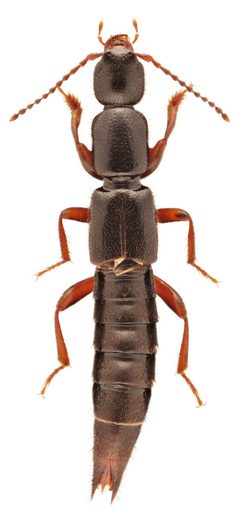
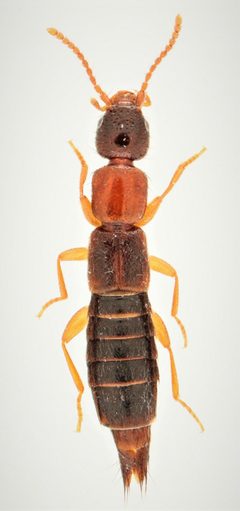
7Medonina is a subtribe of rove beetles ( Staphylinidae) established by Casey in 1905. As of 2024, it encompasses 49 distributed across multiple continents. The subtribe belongs to the tribe Lathrobiini within the Paederinae. Members are small to medium-sized predatory beetles commonly found in leaf litter, soil, and other decaying organic matter.
Pronunciation
How to pronounce Medonina: /mɛˈdɒnɪnə/
These audio files are automatically generated. While they are not always 100% accurate, they are a good starting point.
Identification
Medonina can be distinguished from related subtribes within Lathrobiini by subtle morphological characters of the and genital structures. The subtribe generally comprises small, slender rove beetles with the characteristic short exposing most of the typical of Staphylinidae. Generic-level identification requires examination of mouthpart structure, tarsal formula, and male genitalia.
Images
Habitat
within Medonina inhabit moist terrestrial microhabitats, particularly leaf litter, decaying wood, compost, moss, and soil horizons rich in organic matter. Some have been recorded from riparian zones and flood debris. The subtribe shows preference for humid, shaded environments with abundant decomposer fauna.
Distribution
Medonina has a distribution with recorded from North America, South America, Europe, Asia, Africa, and Australasia. Individual genera often show restricted regional distributions; for example, Achenomorphus is primarily Palearctic, while other genera are to specific biogeographic regions.
Ecological Role
As part of the predatory rove beetle fauna, Medonina function as of small soil and litter , including springtails, mites, , and insect larvae. They contribute to nutrient cycling through their role in regulating decomposer .
Human Relevance
Medonina has no documented direct economic importance. Individual may occur in agricultural soils and composting systems where they contribute to of pest , though this has not been specifically studied at the subtribe level.
Similar Taxa
- StilicinaAnother subtribe within Lathrobiini; distinguished by differences in aedeagal structure and tarsal segmentation patterns.
- LathrobiinaThe nominotypical subtribe of Lathrobiini; separation relies on subtle characters of the internal sac and parameres of the male genitalia.
More Details
Taxonomic history
The subtribe was established by Casey in 1905 but has undergone significant redefinition with the advent of phylogenetic . The current circumscription includes 49 as of 2024, though generic boundaries remain under investigation for several groups.
Research status
Medonina is taxonomically well-defined at the subtribe level, but many constituent are poorly studied with numerous awaiting description. The subtribe has not been subject to comprehensive molecular phylogenetic analysis.