
Deleaster dichrous
(Gravenhorst, 1802)
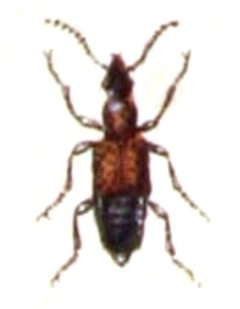
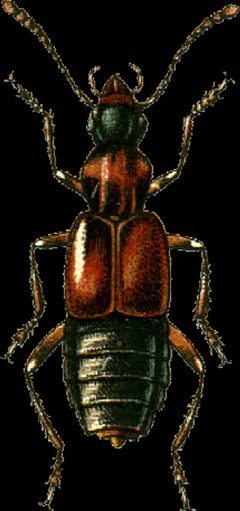
Deleaster dichrous is a rove beetle (Staphylinidae: Oxytelinae) native to the Western Palaearctic, with established introduced in northeastern North America. measure 6.5–8 mm and display distinctive coloration with dark brown and contrasting with orange , legs, and . The occupies diverse open from grasslands to coastal areas and exhibits tendencies, with adults active primarily in spring and summer.

Pronunciation
How to pronounce Deleaster dichrous: //dɛliˈæstər ˈdaɪkroʊs//
These audio files are automatically generated. While they are not always 100% accurate, they are a good starting point.
Identification
6.5–8 mm in length. Bicolored: and dark brown; , legs, and remainder of body orange. Distinguished from other Deleaster by this specific color pattern and body proportions; D. bactrianus (now synonymized) was historically separated by subtle morphological differences now considered intraspecific variation.
Images
Habitat
Native European range: lowlands and mountain bases, open grasslands, damp forests, coastal areas with long grass cover. Also occurs in anthropogenic including parks and landfills. Introduced North American occupy similar open, grassy environments.
Distribution
Native: Western Palaearctic including Europe, Russia (European part and western Siberia), Armenia, Azerbaijan, Georgia, Turkey, Iran, Turkmenistan, Morocco, Algeria, Tunisia. Introduced: Canada (Labrador, Manitoba, New Brunswick, Newfoundland, Nova Scotia, Ontario, Quebec), USA (Maine, New Hampshire, New York, Ohio).
Seasonality
most common during spring and summer.
Behavior
Primarily ; commonly attracted to light traps. When disturbed, releases a defensive fluid to deter ; this secretion is not harmful to humans.
Human Relevance
Non-pest ; defensive secretions pose no risk to humans. Occurs in urban parks and landfills, indicating to anthropogenic disturbance.
Similar Taxa
- Deleaster bactrianusSynonymized with D. dichrous; previously considered distinct based on subtle morphological differences now regarded as intraspecific variation in the Western Palaearctic.