
Oxyporinae
Fleming, 1821
Cross-toothed Rove Beetles
Genus Guides
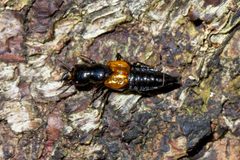
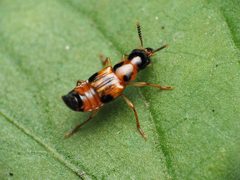
1Oxyporinae is a of rove beetles (Staphylinidae) containing a single , Oxyporus, with approximately 132 distributed worldwide. These beetles are obligate fungivores with a tightly linked to fungi. They are notable for their distinctive mandibular and mouthpart .

Pronunciation
How to pronounce Oxyporinae: /ˌɒksɪˈpɔːrɪniː/
These audio files are automatically generated. While they are not always 100% accurate, they are a good starting point.
Identification
Distinguished from other Staphylinidae by the combination of prominent and extremely large, hatchet-shaped (securiform) labial palpomeres. The 5-5-5 tarsal formula is shared with most rove beetles and not diagnostic alone. -level identification traditionally relied on external , but many such traits are now known to be highly variable; male genitalia, particularly structure, and (CO1) provide more reliable species delimitation.
Images
Habitat
Found in association with fleshy fungi and mushrooms, which serve as food, shelter, and reproductive sites. include forests and other environments where suitable fungal fruiting bodies occur.
Distribution
Worldwide distribution. The Oxyporus occurs across multiple continents including North America, Eurasia, and other regions. Specific documented occurrences include Russia (10 ), Japan, and North America (six species).
Seasonality
Activity likely coincides with fungal fruiting periods, though specific seasonal patterns are not well documented in the provided sources.
Diet
Obligate fungivores; and larvae feed on fungi.
Host Associations
- fleshy fungi - foodprimary food source; entire lifecycle dependent on fungi
- mushrooms - females construct -laying chambers within fungal fruiting bodies
Life Cycle
Females construct -laying chambers within fungal fruiting bodies. Larvae develop within fungi, with the entire lifecycle completed in association with fungal .
Behavior
Multiple individuals frequently co-occur in the confined spaces within fungal bodies, leading to intense intra- and inter- interactions during mating. This crowded environment has been hypothesized to drive the diversification of male genital structures.
Ecological Role
Specialized fungivores that exploit fungal fruiting bodies as a food resource and microhabitat. Their tight association with fungi suggests they may play a role in fungal spore or nutrient cycling, though this has not been explicitly documented.
Human Relevance
Of interest to mycologists and entomologists; often encountered by scientists inspecting mushrooms and fleshy fungi. No documented economic importance or pest status.
Similar Taxa
- other Staphylinidae subfamiliesOxyporinae can be distinguished by the unique combination of prominent and large securiform labial palpomeres, features not found together in other rove beetle .
More Details
Taxonomic history
First described by Erichson in 1839 (though authorship is also attributed to Fleming, 1821). The contains only the Oxyporus, making it monogeneric.
Species delimitation challenges
Traditional alpha- in Oxyporus was hampered by unusually character-poor male genitalia and high variability in external morphological traits previously used for identification. Recent systematic revisions demonstrate that CO1 barcodes and provide congruent, reliable boundaries.
Sources and further reading
- BugGuide
- Wikipedia
- iNaturalist taxon
- NCBI Taxonomy
- Catalogue of Life
- DNA-barcode and endophallus morphology delimit congruent species in a systematic revision of the oxyporine rove beetles of Russia (Coleoptera: Staphylinidae: Oxyporinae)
- Revision of the fungivorous genus Oxyporus ( s. str. ) (Coleoptera: Staphylinidae: Oxyporinae) of Japan, with preliminary analysis of host relationships, species richness and zoogeography