
Eusphalerum convexum
(Fauvel, 1878)
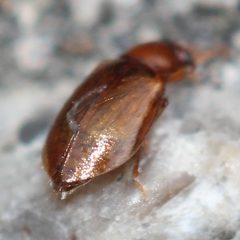
Eusphalerum convexum is a small rove beetle in the Staphylinidae, Omaliinae. The is known from eastern North America, with records spanning Canada and the northeastern and midwestern United States. Like other members of the , it is associated with decaying organic matter and fungal .
Pronunciation
How to pronounce Eusphalerum convexum: /juːsˈfælɛrəm kɒnˈvɛksəm/
These audio files are automatically generated. While they are not always 100% accurate, they are a good starting point.
Identification
Eusphalerum convexum can be distinguished from by its strongly convex , which give the its name. The pronotum is typically narrower than the base of the elytra. Members of Eusphalerum are small (usually 2–4 mm), with relatively short elytra that expose most of the , and can be separated from other Omaliinae by the combination of compact body form, distinct pronotal shape, and antennal structure. Definitive identification to species level requires examination of genitalia and comparison with .
Images
Habitat
Found in decaying plant matter, leaf litter, and fungal fruiting bodies. Associated with moist forest floor environments where decomposition processes are active.
Distribution
Eastern North America: Canada (New Brunswick, Newfoundland and Labrador, Nova Scotia, Ontario, Prince Edward Island, Quebec) and United States (Connecticut, District of Columbia, Indiana, Kentucky, Massachusetts, Maine, Minnesota, Missouri, North Carolina, New Hampshire, New York, Ohio, Pennsylvania, Rhode Island, Virginia, Vermont, West Virginia).
Similar Taxa
- Eusphalerum minutumOverlapping distribution and similar size; distinguished by less convex and different pronotal proportions.
- Other Omaliinae genera (e.g., Omaliinae)Similar general appearance and ; Eusphalerum have more compact, convex body form and distinctive antennal club structure.
More Details
Taxonomic Note
The was originally described by Fauvel in 1878. The Eusphalerum contains numerous small, convex species that are challenging to distinguish without detailed examination. The Omaliinae is one of the most diverse lineages within Staphylinidae.
Collection Records
Based on 37 iNaturalist observations and museum records, the appears most frequently collected in spring and early summer, though this may reflect collector activity rather than true seasonality.