
Acidota crenata
(Fabricius, 1792)
Crenate Ocellate Rove Beetle
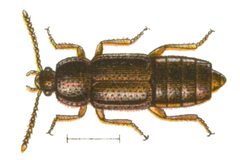
Acidota crenata is a of rove beetle in the Staphylinidae, Omaliinae. The species has a Holarctic distribution, occurring across northern and central Europe, extending eastward through Russia to East Asia, and present in North America including Canada and the United States. It is one of approximately 15 species in the Acidota, which are characterized by distinctive ocellate (-spotted) patterns on the . The specific epithet 'crenata' refers to the crenate (scalloped or notched) margins characteristic of this species.
Pronunciation
How to pronounce Acidota crenata: //əˈsɪdəʊtə krɪˈnɑːtə//
These audio files are automatically generated. While they are not always 100% accurate, they are a good starting point.
Identification
Distinguished from other Acidota by the crenate (notched or scalloped) character referenced in its , most evident on the abdominal sternites or elytral margins. The ocellate elytral pattern—pale circular or oval markings on a dark background—separates Acidota from most other Omaliinae . Within Acidota, A. crenata is most similar to A. subcarinata and A. quadrata; careful examination of the degree of crenation on abdominal margins and the precise configuration of elytral markings is required for definitive identification. Males may be distinguished by subtle differences in the eighth abdominal sternite.
Images
Appearance
Medium-sized rove beetle with compact body form typical of the Omaliinae. The display distinctive ocellate (-like) markings, with the specific epithet 'crenata' referring to the crenate or scalloped margins present on some body . Body coloration generally dark with contrasting pale markings forming the characteristic ocellate pattern. relatively short, not extending to apex of elytra. Pronotum transverse with rounded lateral margins.
Habitat
Found in moist forested environments, particularly in association with decaying organic matter. Occurs in and temperate forests, often in mossy areas, under bark, and in leaf litter. In North America, recorded from coniferous and mixed hardwood forests. The shows affinity for cool, humid microhabitats typical of northern latitudes and higher elevations.
Distribution
Holarctic. In Europe: widespread from the British Isles and Ireland eastward through Scandinavia, central Europe (Germany, France, Austria, Czech Republic, Poland), and south to the Balkans and Italy. Extends east through European Russia, Siberia, and the Russian Far East to Japan (Hokkaido, Honshu), Korea, Mongolia, and northern China (Gansu). In North America: recorded from across Canada and the northern United States. Also present in Iceland, Turkey, Iran, Georgia, Armenia, and Uzbekistan.
Similar Taxa
- Acidota subcarinataSimilar ocellate elytral pattern and body proportions; distinguished by less pronounced crenation on abdominal margins and subtle differences in male genitalia.
- Acidota quadrataOverlapping distribution and similar preferences; A. quadrata has more quadrate (square-shaped) pronotum and reduced crenation.
- Eusphalerum speciesOther Omaliinae with pale elytral markings; Eusphalerum lacks the distinct ocellate pattern and crenate margins, and typically has more elongate body form.
More Details
Taxonomic Note
Authorship is sometimes cited as (Fabricius, 1793) in sources following NCBI , though the original description as Staphylinus crenatus dates to 1792. The was transferred to the Acidota by Thomson in 1858.
Nomenclatural Stability
The Acidota has remained relatively stable taxonomically, though the number of recognized has fluctuated between 12 and 18 depending on author. A. crenata has consistently been treated as valid since its description.
Sources and further reading
- BugGuide
- Wikipedia
- GBIF taxonomy match
- iNaturalist taxon
- NCBI Taxonomy
- Catalogue of Life
- USDA-ARS Researcher to Give UC Davis Seminar on Beech Leaf Disease | Bug Squad
- Shahid Siddique Lab Shines at International Society of Nematologists' Meeting | Bug Squad
- New Guide Highlights IPM for Boxwood Pests
- When the American Chestnut Vanished, What Happened to Insects That Fed On It?
- longhorned beetles | Beetles In The Bush | Page 10