
Xenodusa cava
(LeConte, 1863)
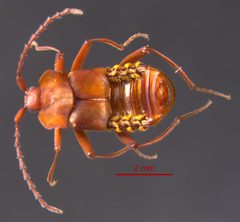
Xenodusa cava is a small rove beetle (Staphylinidae) distributed across eastern and central North America. It is obligately myrmecophilous, with larvae developing inside colonies where they exhibit specialized begging and feed on ant . This represents a classic example of in beetles.
Pronunciation
How to pronounce Xenodusa cava: //ˌzɛnəˈduːsə ˈkævə//
These audio files are automatically generated. While they are not always 100% accurate, they are a good starting point.
Images
Habitat
Associated with colonies; specific nesting substrate preferences of ants determine local occurrence. Host ant dictates microhabitat conditions.
Distribution
Eastern and central North America: Canada (Ontario) and United States (Arkansas, Colorado, Connecticut, District of Columbia, Iowa, Illinois, Indiana, Kansas, Kentucky, Massachusetts, Maryland, Maine, Michigan, Minnesota, Missouri, Nebraska, New Hampshire, New Jersey, New York, Ohio, Oklahoma, Pennsylvania, Rhode Island, Virginia, Wisconsin, West Virginia).
Diet
Larvae have been observed consuming larvae ( /); feeding habits not documented.
Host Associations
Life Cycle
Larval development occurs within colonies; specific details of and not documented.
Behavior
Larvae exhibit begging toward ants within colonies, a specialized for obtaining food and integration into colony social structure.
Ecological Role
Myrmecophilous ; larvae function as or social within colonies, potentially affecting colony .
Similar Taxa
- Other Xenodusa speciesCongeneric likely share myrmecophilous habits but differ in distribution and possibly specificity; morphological separation requires detailed examination.
- Other Lomechusini rove beetlesMany tribe members are myrmecophilous; distinguishing X. cava requires attention to subtle morphological characters and geographic range.
More Details
Myrmecophily Type
The larval begging and consumption of represents a specialized form of inquilinism, where the exploits the social structure and resources of the colony rather than living as a neutral guest.
Sources and further reading
- BugGuide
- Wikipedia
- GBIF taxonomy match
- iNaturalist taxon
- Catalogue of Life
- Second COVID-19 Symposium: Well Done and Much Appreciated | Bug Squad
- Two new bird species from the Amazon Basin described based on bioacoustics and morphological data | Blog
- Caddisfly Swarms: Harmless, But Really Annoying
- Brazil | Blog - Part 2
- Bug Eric: Spider Sunday: Triangle Spiders
- Bug Eric: July 2020