
Myrmecocephalus cingulatus
(LeConte, 1866)
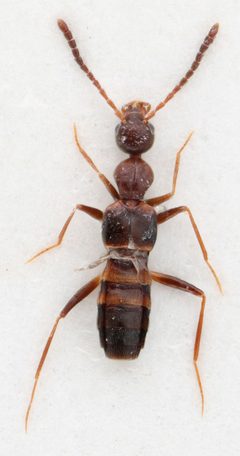
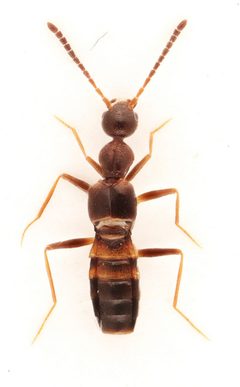
Myrmecocephalus cingulatus is a small rove beetle (Staphylinidae: Aleocharinae) in the tribe Falagriini. It occurs across eastern North America from Canada to the southern United States. The name 'Myrmecocephalus' (-) refers to the ant-like appearance of these beetles. This is rarely collected and poorly known biologically.
Pronunciation
How to pronounce Myrmecocephalus cingulatus: /mɪrˌmiːkoʊˈsɛfələs sɪŋˈɡjʊlətəs/
These audio files are automatically generated. While they are not always 100% accurate, they are a good starting point.
Identification
Distinguished from other Myrmecocephalus by genitalic characters and subtle external features requiring microscopic examination. The -like body form separates it from most other staphylinid , though it may be confused with other myrmecophilous or myrmecoid aleocharines. Accurate identification to species level typically requires dissection and comparison with or authoritative keys.
Images
Appearance
Small rove beetle with compact, -like body form. Short leave most of exposed, typical of Staphylinidae. and pronotum often appear constricted, contributing to the myrmecoid (ant-mimicking) silhouette. Body coloration and exact size measurements are not well documented in accessible literature.
Habitat
Specific associations are poorly documented. Related in Falagriini are often found in decaying organic matter, leaf litter, and other moist microhabitats. The species has been collected in wooded and semi-wooded areas across its range.
Distribution
Eastern North America: Canada (Nova Scotia, Ontario, Quebec) and USA (Alabama, Arkansas, District of Columbia, Florida, Iowa, Illinois, Indiana, Kansas, Kentucky, Louisiana, Maryland, Michigan, Missouri, Mississippi, North Carolina, New Hampshire, New Jersey, New York, Ohio, Pennsylvania, Virginia, Wisconsin, West Virginia). Records from Galapagos Islands are erroneous.
Seasonality
Collection records span multiple months, but specific seasonal activity patterns are not well documented. have been recorded from spring through fall in temperate portions of the range.
Behavior
Specific are undocumented. The -like suggests possible myrmecophily (ant association) or myrmecophagy (ant ), though this remains unconfirmed for this .
Human Relevance
No known economic or medical significance. Occasionally encountered by entomologists in litter and pitfall trap collections.
Similar Taxa
- Other Myrmecocephalus speciesRequire genitalic examination and detailed morphological comparison for reliable separation
- Other ant-mimicking Aleocharinae (e.g., some Myrmecopora, Pella)Share convergent myrmecoid body form; separation requires examination of mouthpart structure, tarsal formula, and other subtle characters
More Details
Nomenclatural note
Authority sometimes cited as MacLeay, 1871 in some databases, but original description by J.L. LeConte in 1866 is the accepted authority. The Myrmecocephalus was established by MacLeay in 1871, which may explain the confusion in some sources.
Taxonomic history
Placed in tribe Falagriini within the megadiverse Aleocharinae. The Falagriini are a moderately diverse tribe of small aleocharines, many with poorly known .