
Tetradonia
Wasmann, 1894
Species Guides
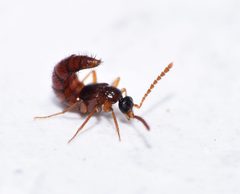
1Tetradonia is a of rove beetles (Staphylinidae: Aleocharinae) that are obligate of army ants in the New World. These beetles are the only described symbionts known to regularly prey on army ant , primarily targeting dying or injured individuals. specificity varies considerably among , ranging from that associate with multiple Eciton species to restricted to single host species. The genus was established by Wasmann in 1894 and currently contains at least five described species, with ongoing research revealing additional diversity through integrative .
Pronunciation
How to pronounce Tetradonia: /ˌtɛtrəˈdoʊniə/
These audio files are automatically generated. While they are not always 100% accurate, they are a good starting point.
Identification
Tetradonia can be distinguished from other army ant-associated rove beetles by morphological features detailed in species-level keys, including antennal proportions and elytral surface texture. Tetradonia laselvensis has longer than the combined length of , pronotum, and , while T. cf. marginalis has shorter antennae with segments IX and X almost as long as wide and weakly granulate-punctate elytra. Accurate identification requires examination of these subtle morphological characters combined with association data.
Images
Habitat
Distribution
New World tropics. Documented from Rica (La Selva Biological Station) and Colombia (Parque Nacional Natural Serranía de Chiribiquete). Associated with army ant across the Neotropical range of Eciton and Neivamyrmex .
Diet
Host Associations
- Eciton burchellii foreli - such as T. laticeps parasitize this
- Eciton hamatum - for both and Tetradonia
- Eciton vagans angustatum -
- Eciton dulcium crassinode -
- Eciton mexicanum -
- Eciton lucanoides conquistador -
- Neivamyrmex gibbatus -
- Neivamyrmex pilosus mexicanus -
Behavior
Attacks army ant during colony emigrations. Exhibits varying degrees of specificity: some are associating with all six local Eciton species, while others are primarily restricted to E. hamatum.
Ecological Role
Myrmecophile and within army ant - . Occupies a unique trophic position as the only described symbiont that regularly preys on army ant .
Similar Taxa
More Details
Taxonomic History
Originally described by Wasmann in 1894. A 2016 integrative taxonomic study using and (COI, wingless, and CAD genes) identified five at La Selva Biological Station, including two new to science.
Sources and further reading
- BugGuide
- Wikipedia
- GBIF taxonomy match
- iNaturalist taxon
- NCBI Taxonomy
- Catalogue of Life
- Community Sampling and Integrative Taxonomy Reveal New Species and Host Specificity in the Army Ant-Associated Beetle Genus Tetradonia (Coleoptera, Staphylinidae, Aleocharinae)
- Correction: Community Sampling and Integrative Taxonomy Reveal New Species and Host Specificity in the Army Ant-Associated Beetle Genus Tetradonia (Coleoptera, Staphylinidae, Aleocharinae)
- Correction: Community Sampling and Integrative Taxonomy Reveal New Species and Host Specificity in the Army Ant-Associated Beetle Genus Tetradonia (Coleoptera, Staphylinidae, Aleocharinae)