
Necrodes surinamensis
(Fabricius, 1775)
Red-lined Carrion Beetle
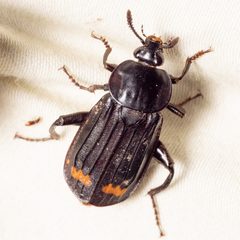
Necrodes surinamensis, commonly known as the red-lined carrion beetle, is a of carrion beetle in the Staphylinidae ( Silphinae). It is found throughout North America, with documented records across Canada and the United States. The species is associated with carrion and plays a role in decomposition processes.
Pronunciation
How to pronounce Necrodes surinamensis: /ˈnɛkroʊdiːz ˌsʊrɪnəˈmɛnˌsɪs/
These audio files are automatically generated. While they are not always 100% accurate, they are a good starting point.
Images
Distribution
North America, including Canada (Alberta, British Columbia, Manitoba, New Brunswick, Newfoundland and Labrador, Nova Scotia, Ontario, Prince Edward Island, Quebec, Saskatchewan) and the United States (widespread across most states including Alabama, Arkansas, Connecticut, Delaware, Florida, Georgia, Idaho, Illinois, Indiana, Iowa, Kansas, Kentucky, Louisiana, Maine, Maryland, Massachusetts, Michigan, Minnesota, Mississippi, Missouri, Montana, Nebraska, New Hampshire, New Jersey, New Mexico, New York, North Carolina, North Dakota, Ohio, Oklahoma, Oregon, Pennsylvania, Rhode Island, South Carolina, South Dakota, Tennessee, Texas, Utah, Vermont, Virginia, Washington, West Virginia, Wisconsin, Wyoming, and Washington D.C.).
Diet
Carrion. The is known to feed on decaying animal matter.
Ecological Role
The contributes to decomposition of carrion, facilitating nutrient cycling in terrestrial .
More Details
Taxonomic Note
There is some discrepancy in assignment across sources. While some references list this in Silphidae, modern taxonomic treatments (GBIF, Catalogue of Life) place it in Staphylinidae, Silphinae. The species epithet 'surinamensis' suggests a type locality in Suriname, though the species is now considered native to North America.
Observation Data
iNaturalist records indicate at least 1,704 observations of this , suggesting it is relatively well-documented and encountered by naturalists.