
Nicrophorus investigator
Zetterstedt, 1824
Banded Sexton Beetle, Banded Burying Beetle
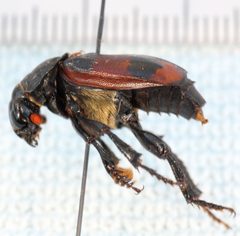
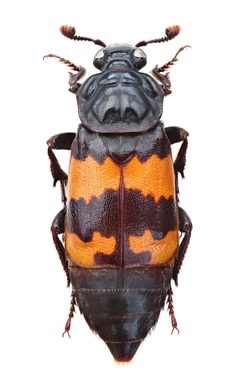
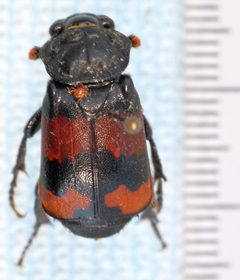
Nicrophorus investigator is a burying first described by Johan Wilhelm Zetterstedt in 1824. It is an obligate carrion breeder that buries small vertebrate carcasses for rearing offspring, exhibiting biparental care. are tightly linked to small mammal abundance, with preferred carcass sizes of 16–48 grams. The has also been documented breeding on Pacific salmon carcasses in coastal British Columbia, where it may exhibit communal breeding on this rich, reliable resource. It serves as a for phoretic mites that discriminate among individual male beetles.
Pronunciation
How to pronounce Nicrophorus investigator: /nɪˈkrɒfərəs ɪnˈvɛstəˌgeɪtər/
These audio files are automatically generated. While they are not always 100% accurate, they are a good starting point.
Images
Habitat
Found in forested and riparian where small vertebrate carcasses occur. In Pacific coastal regions, utilizes salmon carcasses in riparian zones. Requires environments where carrion resources are accessible for burial and rearing.
Distribution
Holarctic distribution. Present across Europe, Russia (European part to Far East), Turkey, Armenia, Azerbaijan, Georgia, Iran, Afghanistan, Turkmenistan, Uzbekistan, Tajikistan, Kyrgyzstan, Kazakhstan, Pakistan, Mongolia, Japan, Korea, northern India, China, Canada, and the United States.
Diet
and larvae feed on vertebrate carrion. Adults regurgitate liquefied carrion to feed larvae. Documented to utilize small rodent carcasses (Peromyscus maniculatus, Microtus montanus, Zapus princeps, Tamias minimus, Thomomys talpoides) and Pacific salmon carcasses (Oncorhynchus spp., particularly chum and pink salmon).
Host Associations
- phoretic mites - Mites discriminate among individual male N. investigator , indicating selective host choice
Life Cycle
are laid on soil within the buried carcass crypt. Larvae hatch and are fed by both parents through regurgitation of liquefied carrion. Larvae move into a chamber excavated in the carcass ball as they grow, feeding until only bones remain. Parents may adjust size by consuming excess young if carrion is insufficient. Larvae pupate after feeding is complete; depart the nest to seek new carcasses.
Behavior
Buries small vertebrate carcasses by excavating soil beneath the body until it is underground. Both parents cooperate in burying, removing hair or feathers, shaping flesh into a compact ball, and sealing the crypt. Parents defend the against competitors and intruders. May exhibit communal breeding on large salmon carcasses. Phoretic mites show discrimination when selecting among individual male .
Ecological Role
Key scavenger in carrion decomposition systems. Facilitates nutrient cycling by burying and consuming carcasses. Parental care and antimicrobial secretions help regulate microbial on carrion. Serves as for phoretic mites, contributing to microhabitat connectivity. indicate dependence on small mammal , suggesting role as a bioindicator for productivity.
Similar Taxa
- Nicrophorus vespilloidesSimilar size, coloration, and burying ; both exhibit biparental care and utilize small vertebrate carcasses
- Nicrophorus americanusLarger with similar black and orange coloration; distinguished by larger size and endangered status in North America
- Necrophila americanaSympatric silphid that also utilizes carrion but does not bury carcasses; distinguished by lack of parental care and different defensive
More Details
Genomic Resources
sequence available through Wellcome Open Research (PMCID: PMC11391189), published 2024.
Conservation Context
North-coastal breeding on salmon carcasses may be affected by dramatic reductions in salmon spawning over the last century.
Sources and further reading
- BugGuide
- Wikipedia
- GBIF taxonomy match
- iNaturalist taxon
- NCBI Taxonomy
- Congratulations, UC Davis Linnaean Games Team: National Champs! | Bug Squad
- Bohart Museum Spotlight on Yellow-Bellied Burying Beetles | Bug Squad
- How to Become a California Master Beekeeper | Bug Squad
- Research Showcases Best and Brightest Fathers of the Insect World
- Uncategorized | Blog - Part 35
- They eat dead things - Part I - Burying beetles Silphidae — Bug of the Week
- Burying beetle Nicrophorus investigator reproduction on Pacific salmon carcasses
- Resource availability and population dynamics of Nicrophorus investigator , an obligate carrion breeder
- Phoretic Mite Discrimination Among Male Burying Beetle (<I>Nicrophorus investigator</I>) Hosts
- The genome sequence of the Banded Burying beetle, Nicrophorus investigator Zetterstedt, 1824.