
Ochthebius
Leach, 1815
minute moss beetles
Species Guides
6- Ochthebius apache
- Ochthebius attritus
- Ochthebius cribricollis
- Ochthebius lineatus
- Ochthebius marinus(marine moss beetle)
- Ochthebius puncticollis(minute moss beetle)
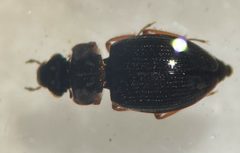
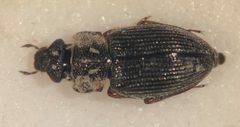
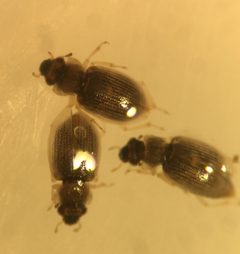
Ochthebius is a large of minute moss beetles in the Hydraenidae, comprising at least 460 described . These tiny beetles are predominantly associated with aquatic and semi-aquatic , particularly supratidal rockpools, coastal marshes, and freshwater spray zones. Many species exhibit narrow habitat preferences and restricted distributions, with numerous . The genus shows significant diversity in the Mediterranean region, Africa, and other parts of the world, and includes several cryptic .
Pronunciation
How to pronounce Ochthebius: /ɒkˈθiːbiəs/
These audio files are automatically generated. While they are not always 100% accurate, they are a good starting point.
Images
Habitat
Supratidal rockpools, supralittoral coastal crevices, coastal marshes, and freshwater spray zones on protruding rocks in streams. Many are restricted to specific microhabitats such as small shallow marine rockpools with algal or diatom layers, or the growth of and moss in stream spray zones.
Distribution
Widespread across multiple continents including Europe (western Palaearctic, Mediterranean), Africa (including southern Africa, Madagascar, and various sub-Saharan countries), Asia (Turkey, Thailand), and Australia. Specific regional records include: western Mediterranean coasts, Iberian Peninsula, Sicily, Corsica, Sardinia, Menorca, Balearic Islands, Namibia, South Africa, Lesotho, Zimbabwe, Angola, Mozambique, Kenya, Ethiopia, and coastal localities in Queensland, Australia.
Life Cycle
Multivoltine in studied ; breeding periods extend through much of the year with peak activity in spring and autumn. , larval, and pupal stages occur; larval instars II and III have been described for some species. Some species show winter limitation in oviposition and larval development, while others are not limited by low temperatures.
Behavior
and larvae are present throughout the year in some , with seasonal peaks in activity. Coexistence of multiple congeneric species occurs in shared such as supratidal rockpools, with temporal differentiation in breeding periods and differential temperature enabling partitioning of resources.
Ecological Role
Inhabitants of extreme and fragmented coastal and freshwater ; contribute to biodiversity in ecotonal zones between land and sea. Some show low genetic diversity and high connectivity among , suggesting effective mechanisms in fragmented rockpool environments.
Human Relevance
Some are of conservation concern due to restricted ranges and specificity. Coastal urbanization, tourist activities, and pollution of marine rockpools threaten vulnerable species. The serves as a model for studying genetics, cryptic speciation, and climate change in fragmented habitats.
Sources and further reading
- BugGuide
- Wikipedia
- GBIF taxonomy match
- iNaturalist taxon
- NCBI Taxonomy
- Catalogue of Life
- The Ochthebius (Coleoptera, Hydraenidae) from western Palaearctic supratidal rockpools
- Life cycle differences between two coexisting species of supratidal rockpools: Ochthebius quadricollis Mulsant, 1844 and Ochthebius lejolisii Mulsant & Rey, 1861 (Coleoptera, Hydraenidae)
- Overlooked coastal habitats expose a new species: Ochthebius vilanovensis sp. nov. (Coleoptera, Hydraenidae)
- Gene pools in rockpools: coastal Ochthebius beetles across the western Mediterranean
- Taxonomical and bionomical notes on the Sicilian endemic water beetle Ochthebius (Cobalius) biltoni (Coleoptera: Hydraenidae)
- New species and new collection records of aquatic beetles in the genus Ochthebius Leach from southern Africa (Coleoptera: Hydraenidae)
- A review of the coastal marsh water beetle Ochthebius queenslandicus Hansen (Coleoptera: Hydraenidae)
- Taxonomical and bionomical notes on the Sicilian endemic water beetle Ochthebius (Cobalius) biltoni (Coleoptera: Hydraenidae)
- Taxonomic revision of African water beetles in the genus Ochthebius Leach (1815), subgenus Aulacochthebius Kuwert (1887) (Coleoptera: Hydraenidae)
- Ochthebius ustaoglui sp. nov. (Coleoptera: Hydraenidae), a new species of the O. metallescens group from Turkey
- Description of the larva of <i>Ochthebius capicola</i> (Coleoptera: Hydraenidae) from marine rockpools of South Africa
- Differentiation of South African coastal rock pool Ochthebius is associated with major ocean currents (Coleoptera: Hydraenidae)
- New records of the minute moss beetle Ochthebius (Enicocerus) colveranus Ferro, 1979 in Slovakia (Coleoptera, Hydraenidae)
- Notes on the distribution and habitat of Ochthebius lobicollis Rey, 1885, a poorly known north-western Mediterranean coastal species (Coleoptera: Hydraenidae)
- Description of Ochthebius (Asiobates) irenae sp. n. (Coleoptera: Hydraenidae) from the Iberian Peninsula, with Notes on its Ecology